Travertine Trays Wholesale: Material, Finish and Custom Order Checklist
TL;DR: When sourcing travertine trays wholesale, specify the finished object rather than relying on the word beige. Confirm the material appearance, pore and filling preferences, surface finish, geometry and intended use. Compare a finished sample with the objects it will hold. DeHong Stone reviews custom natural stone tray inquiries individually; availability, treatment, quantities and timing should be agreed for the selected design rather than inferred from a design illustration.
Published
Updated
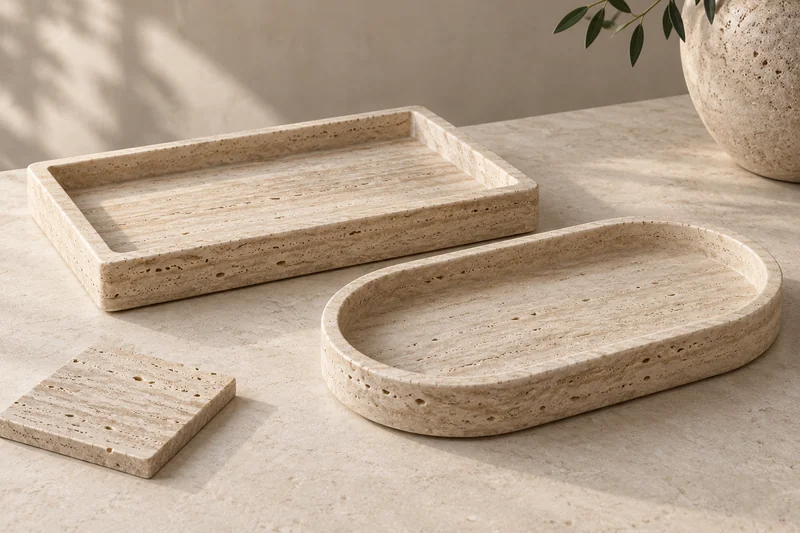
Begin with the role of the tray
Travertine can bring a quieter, textured material character to a small object. But the desired look does not define its function. Explain whether the tray is for a dry display, jewelry storage, a decorative arrangement or a setting where water and cosmetics may be present.
A buyer building a retail collection also needs to consider what the eventual customer will understand from the product description. A styled photograph can imply wet use or direct food contact even when neither has been assessed. Choose the use first and describe the finished product accordingly.
For a commercial display, provide the items and the space available. A fragrance bottle, folded card or jewelry box can require a different interior layout. This makes the supplier's response more useful than a request for the most popular tray with no supporting dimensions.
Do not treat beige as a complete material specification
Discuss background tone, movement and the appearance of the visible faces. A warm light sample and a darker, more strongly marked piece can both be described with similar commercial names. Decide what coordinates with your existing materials and what would be unacceptable.
Ask for representative real references rather than a single ideal image. The relevant question is what range is proposed for the order. If several trays will be used together, review them as a group while allowing for natural differences.
Small samples help communicate tone and finish, but cannot establish the exact layout on every finished piece. A selected specimen may be useful for a color-sensitive decision; a broader range is useful for understanding variation. State which kind of approval you need rather than asking a photograph to provide both.
Make pore and filling preferences explicit
Travertine commonly presents natural cavities, and their appearance and treatment can affect the finished character. Discuss the proposed surface with the maker. An open, textured appearance and a filled appearance are different design choices, not interchangeable descriptions of the same approval.
Ask how the selected treatment will look on the actual sample, including visible edges and the interior. Do not assume that a general sealing step fills physical openings. Where filling is proposed, its compatibility, appearance and intended use should be reviewed with the complete surface system.
A deliberately natural texture still needs to suit cleaning and handling. For a tray used around small items, decide whether visible openings are acceptable in the contact area. For wet or cosmetic exposure, discuss the actual conditions and any sample assessment rather than treating the stone name as a performance guarantee.
Travertine naturally contains voids. The Natural Stone Institute explains that accessible surface voids may be filled with cementitious or resinous material; filling the face does not fill every concealed void inside the stone. Its travertine voids handout discusses flooring, so it does not establish a failure rate or service life for a small tray. It does explain why a photograph of a smooth face cannot prove that an object is solid throughout.
For a tray, turn the broad choice into a drawing note. Identify the internal compartments, upper rim, outside edge and underside separately. Ask which faces will be filled, what filler is proposed, and how its colour and finish will be approved. “Natural finish” is too vague to settle those decisions.
Honing, filling and applying a protective treatment are separate specifications. A honed finish does not tell you whether the pores are open. Filling does not establish waterproofness. A pale cream colour does not identify the quarry, filler or treatment. Confirm the actual stone rather than substituting a commercial colour name for a material specification.
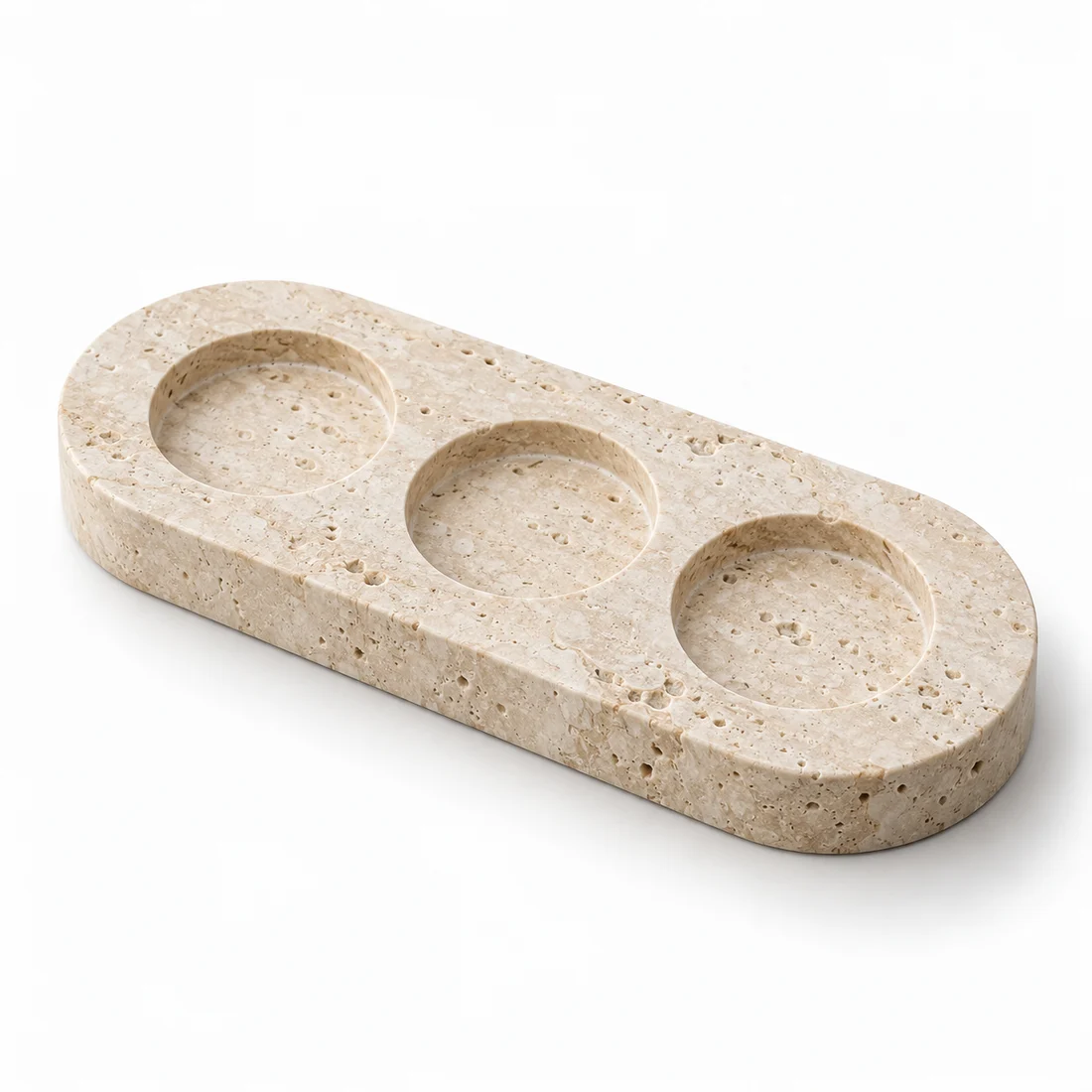
Confirm the finish on a real object
The finish changes how the material reads under light and how it feels. Ask for the proposed finish to be shown on a representative surface and, when the project requires it, a finished tray. A wet picture is not a substitute for viewing the dry result.
Include the recess, rim and underside in the review. The top may satisfy the mood reference while the side edge or interior looks different. These are visible parts of the finished object and should not be left outside the appearance discussion.
Care information should match the material and treatment. Conventional stone impregnation does not create a universal stain-proof surface, and acid-sensitive stone needs appropriate care. For detailed material-care distinctions, consult the Natural Stone Institute guidance and confirm instructions for the actual finish rather than improvising a household treatment. [1]
No such conclusion follows from the word “sealed”. The Natural Stone Institute says impregnating treatments improve stain resistance rather than making stone stain-proof. Its care guidance also cautions that acidic cleaners can etch calcareous stone and recommends suitable mild cleaning, rinsing and drying. Ask for care instructions compatible with the selected stone, filler and treatment.
Put special requirements in the brief: frequent splash exposure, standing water, cosmetics, disinfectants, direct food contact or a particular cleaning chemical. Seek relevant supplier documentation and agree verification; do not infer suitability from a decorative image or a water-beading demonstration. The guide to liquid exposure and treatment trials explains how to separate stain resistance from surface damage.
Compare the specification choices
| Item | What to request | Why it matters |
|---|---|---|
| Appearance | Real material references and acceptable range | Reduces surprise from broad color descriptions |
| Pores | Proposed open or filled treatment | Changes visual texture and contact surfaces |
| Finish | Dry sample in the intended finish | Shows the actual surface rather than a wet image |
| Geometry | Rim, recess, thickness and clear area | Connects styling with usable space |
| Underside | Finish and any proposed protection | Addresses contact with the supporting surface |
| Packing | Unit protection and onward delivery route | Makes the transport proposal relevant |
These decisions should be considered together. A texture that works for a display block may not suit the interior of a tray intended for frequent cleaning. There is no one finish that is best for every collection.
Specify dimensions without sacrificing the design
Provide outer dimensions and usable interior dimensions. Add rim width, total height, recess depth and corner treatment. If you want a subtle visual edge, explain the desired effect and ask for a feasible section rather than assuming the thinnest imagined profile can be made in every material.
Use a full-size outline to check placement, then use a sample to assess the stone itself. The paper outline can reveal an oversized footprint, but it cannot establish texture, weight or the practicality of an edge. These are different approval tools.
For a range of sizes, evaluate the proportions individually. Material features can read differently across a broad oval and a narrow rectangle. Retain the approved drawing versions alongside material references so later changes do not quietly alter the intended character.
Plan quantities and packaging before final costing
Tell the supplier how many pieces are required per design and treatment. Mixed forms and finishes can affect the work involved. If you expect replenishment, discuss it as a separate planning need rather than assuming a future batch can match every natural feature.
Explain the delivery route and whether the trays will be reshipped to end customers. Ask for the proposed unit packaging and carton arrangement, then confirm the packed size and weight. An attractive retail box may need another protective layer for transport.
If testing, special labeling or presentation materials are required, identify them during the quotation stage. Their scope, acceptance criteria and costs need agreement. Do not infer a specific certification or packaging result from photographs of a foam insert.
Request a travertine tray proposal from DeHong Stone
Share your reference or drawing, quantity, dimensions, preferred material appearance, pore treatment, finish and intended use at www.dehongstone.com. Include the destination and packing requirements. A design illustration can communicate direction, but the proposal and sample establish what is actually feasible.
Around 50 pieces may be a starting quantity for discussion for an appropriate small-batch design. Material selection and mixed treatments need individual review. Samples are discussed on FCA terms with full prepayment; small production orders on FCA terms with a 30% deposit and balance before dispatch. The quotation confirms the named place, schedule and final requirements.
Compare the options by what the tray will hold
Use the following as a purchasing review, not a performance ranking. Either option needs approval on the selected material and completed shape.
| Use or decision | Filled faces | Open-texture faces |
|---|---|---|
| Keys, watches and jewellery | Filled facesCheck whether the approved surface is sufficiently even for the contents. Discuss removable soft contact protection. | Open-texture facesTry the actual contents on the sample and check access to small recesses. Do not equate texture with scratch-safe storage. |
| Bathroom bottles or soap dispensers | Filled facesReview the filler, treatment, cleaner and bottle contact together; ask for a completed sample. | Open-texture facesAsk housekeeping to demonstrate cleaning and drying the recesses. Consider a removable insert where the brief requires one. |
| Retail appearance | Filled facesApprove filler colour and the transition between filled areas and stone under the intended lighting. | Open-texture facesAgree where visible openings are acceptable and where they would interrupt an edge, logo or contact area. |
| Repeat orders | Filled facesRecord the approved material and filling specification, including how substitutions require review. | Open-texture facesKeep an agreed range of appearance references; one attractive photograph is not a batch acceptance standard. |
For wet-use layouts, continue with the hotel vanity-tray specification guide. It addresses bottle spacing and handling; this article addresses the separate pore-filling decision. A dry valet brief should not silently become a bathroom-use claim.
Approve the sample in five steps
This is a proposed buyer review procedure, not a laboratory method or a report of DeHong Stone test results. Agree any test conditions and acceptance criteria with the supplier before sampling.
- Label the candidate. Record the supplier's material identification, cutting direction where relevant, finish, filled faces, filler and treatment. Use a drawing revision and sample ID so the approval remains traceable.
- Inspect the complete shape. Review the recess floors, internal corners, divider, outer rim and underside under consistent light. Mark any openings or repairs you need the supplier to explain. Ask about the selected piece rather than predicting strength from a rendering.
- Rehearse actual use. Place the intended keys, watch, jewellery or bottles in the compartments. Lift and remove them as a user would. Check reach, stable support and contact protection; agree dimensions separately using the CAD-to-prototype review.
- Rehearse care. On an agreed test sample, use the proposed cleaning product, cloth and routine according to supplier directions. Include any insert or underside pad. Photograph before and after drying, and record residue, discolouration, finish change or loose material. Do not treat an unrecorded quick rinse as a durability test.
- Keep a written decision. Identify what is accepted, what needs revision and which changes require another sample. Keep photographs, the approved sample and the care instructions together. If buyers disagree about a natural feature, settle the acceptable range before placing the order.
DeHong Stone can review a proposed layout against the small stone tray collection, but those design references do not replace this approval. For a first enquiry, specify the intended contents and whether the surface will be regularly wet.
What should go into the quotation request?
To compare suppliers, send the same specification to each. List quantity by design and material, rather than combining different trays into an unexplained total.
- Intended use, contents and any wet-use or cleaning requirements.
- Drawing with overall and usable compartment dimensions; rim, divider and underside details.
- Actual stone identification, finish and a face-by-face filling requirement, or two clearly separated options to evaluate.
- Appearance references, sample approval requirements and proposed contact protection.
- Sample quantity, initial production quantity, repeat-order expectations and destination.
- Packaging scope, care card, branding, verification costs and what freight or duties the quotation includes.
Request the cost and lead-time implications of the alternatives; neither option should be assumed cheaper for every design. Material availability, minimum quantities, prices and timing require a project quotation. Review current material directions as a starting point, then confirm the actual supply and sample.
FAQ
FAQ 1: Is travertine the same as marble?
Answer: No. They are different natural stone materials. Use the actual proposed material identification rather than assuming a retail category name describes the geology precisely.
FAQ 2: Do visible pores automatically mean poor quality?
Answer: Not automatically. The agreed material character, treatment and intended use determine what is appropriate. Loose grit or damage should be assessed separately from a deliberate texture.
FAQ 3: Does sealing fill the holes?
Answer: Do not assume so. An impregnating treatment and physical filling are different matters. Ask what surface is proposed and inspect a representative sample.
FAQ 4: Can the tray be used in a bathroom?
Answer: Discuss the expected water, products and cleaning routine. Suitability and care should be confirmed for the chosen material and finish rather than inferred from the shape.
FAQ 5: Can I request a lighter or quieter range?
Answer: Explain the appearance priority and provide references. Selection feasibility and the proposed range need confirmation; exact natural patterns should not be promised across every piece.
[1] Natural Stone Institute — Care & Cleaning of Natural Stone
For the wider material choice, read Travertine Explained: Colours, Pores, Finishes and Custom Objects. It covers colour references and pattern selection; this tray guide focuses on the separate filled-versus-unfilled procurement decision.
Further specification questions
Should a custom travertine valet tray be filled or unfilled?
For regularly wiped contact areas, start by evaluating a filled-face sample. For a deliberately open texture, approve the appearance and cleaning method on the complete tray. Neither choice alone proves suitability; decide by the contents, exposure and sample review.
Are visible holes automatically a defect?
No. Natural openings can be part of the specified appearance. Record where openings are acceptable and ask the supplier to assess uncertain edges or contact areas. A natural feature and an acceptable finished detail are different decisions.
Can a design reference confirm the filler or finish?
No. Obtain the material and treatment specification, representative photographs and a physical sample. A design illustration cannot establish filler identity, cleaning compatibility or measured performance.
Apply the guidance to your project
For a project-specific review, send your intended use, drawing or reference, dimensions, material preference, estimated quantity and delivery destination to DeHong Stone. The team can review which details need sample confirmation before quotation.
Website: www.dehongstone.com
Email: hefeng@dehongstone.com
WhatsApp: +86 139 8660 4493
General purchasing guidance is not a project quotation or a material test result. Confirm specifications, verification and terms for the selected sample.
Bring your drawing and project requirements.
Include your intended use, reference, dimensions, material preference and quantity. Agree the feasibility review and sample requirements in writing.