Travertine Explained: Colours, Pores, Finishes and Custom Objects
In brief: Travertine is a naturally porous carbonate stone with a much wider palette than beige. Colour, cutting direction, filling and finish are separate choices. For small custom objects, choose them around the intended use and confirm the result with a representative sample.
Explore the colour and texture references below, then learn how the material forms, why its pores matter and how to turn a preferred look into a practical production brief.
Published
Updated
What is travertine, and how does it form?
Travertine is a sedimentary carbonate stone, commonly described as a type of limestone. In spring systems, mineral-rich water can deposit calcium carbonate as conditions change. At Mammoth Hot Springs, for example, dissolved carbon dioxide escapes as water reaches the surface, helping calcium carbonate precipitate. Repeated deposition produces the layered structures associated with travertine. This geological example explains the material; it is not a statement about the origin of the references shown here. Read the USGS explanation of travertine formation.
Travertine and marble can both be rich in carbonate minerals, but they are not geological synonyms. Marble has undergone metamorphism. For a custom object, the useful question is not simply whether a seller uses the word “marble”; ask what the proposed stone is, how it is prepared and which sample the quotation refers to.
The material name also does not supply a universal density, hardness, water-absorption value or safe minimum thickness. If a property is important to the design, request documentation or an appropriate test for the selected material instead of borrowing a number from another quarry.
Travertine colours: beyond yellow and beige
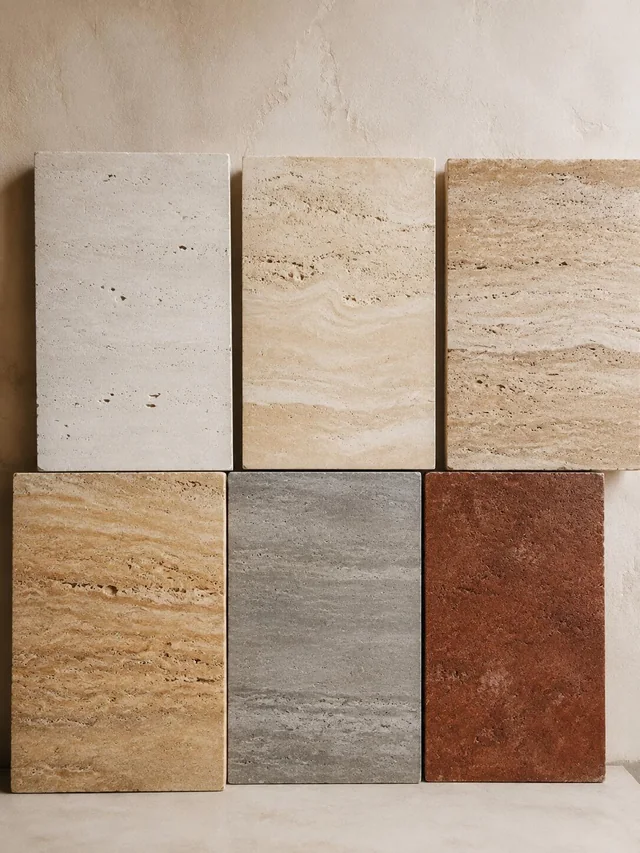
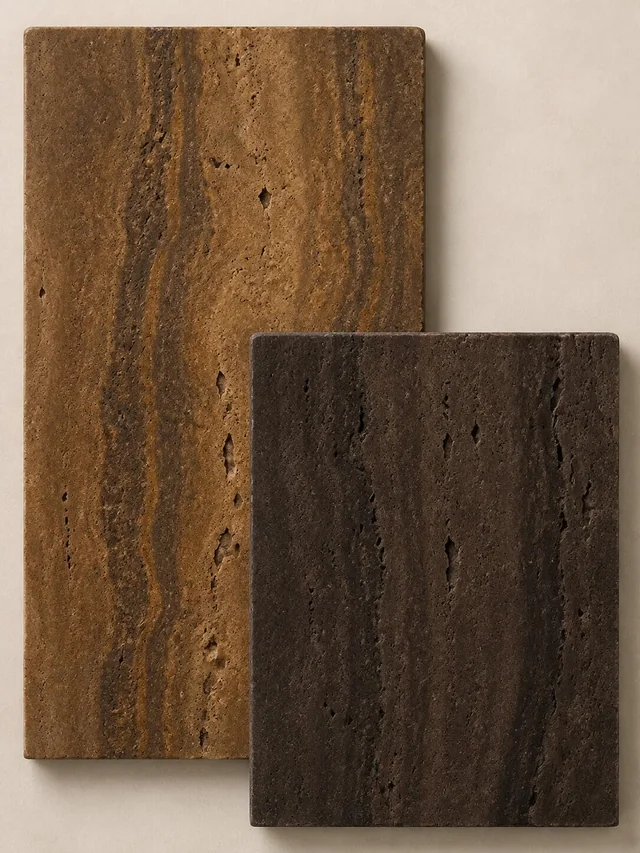
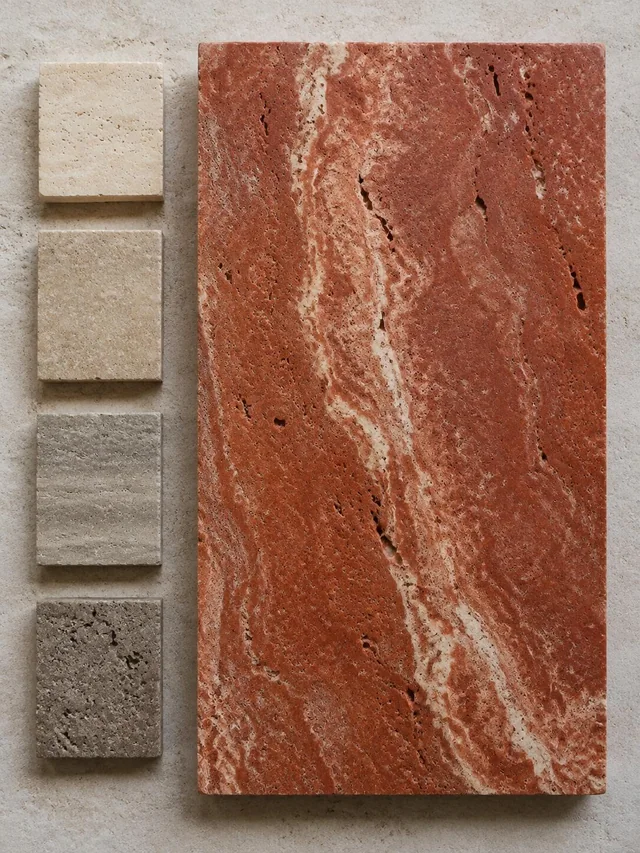
Common colour directions include cream and ivory, beige and gold, silver-grey and greige, brown and walnut-like tones, and red or rust-toned varieties. These are useful design descriptions, not standardised grades. Mineral inclusions can influence colour. The USGS explains that iron oxides can give rocks reddish tones; colour alone does not identify the exact chemistry or origin of an individual sample. Read the USGS explanation of red rock colours.
Compare the background tone, the contrast of bands and the size of visible openings as separate decisions. A pale piece can have strong movement, while a darker piece can read more quietly at a small scale. Lighting, camera white balance, surface finish and adjacent materials can all change the visual impression. Review the dry sample under the lighting in which it will be used.
| Colour direction | Design question | Sample check |
|---|---|---|
| Cream / ivory | Should the object blend into a pale countertop or frame a darker item? | Compare warm and cool undertones against the intended surroundings. |
| Beige / gold | Is a warm accent or a stronger layered pattern preferred? | Review the permitted range of yellow and brown bands. |
| Silver-grey / greige | Should the piece balance warm finishes or echo cooler materials? | Check grey-beige balance and the visibility of fill. |
| Brown / walnut-like | How much contrast should the object have against its contents? | Review dark bands, lighter streaks and the finish together. |
| Red / rust | Is the stone intended as a focal accent? | Confirm an acceptable colour range with the actual supply sample. |
A colour choice is a starting point for sourcing and sample review. It is not a confirmation of availability, an exact match or a promise that every piece will look identical.
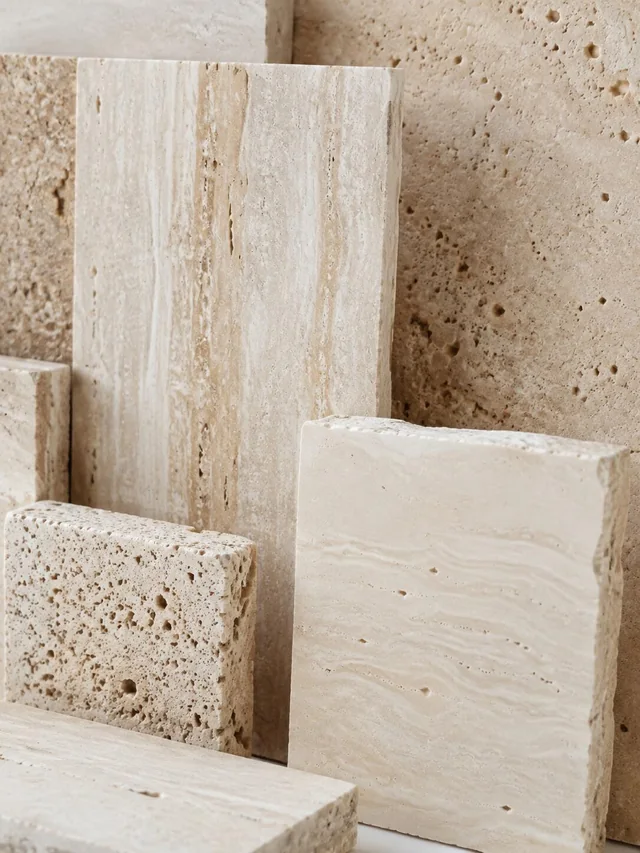
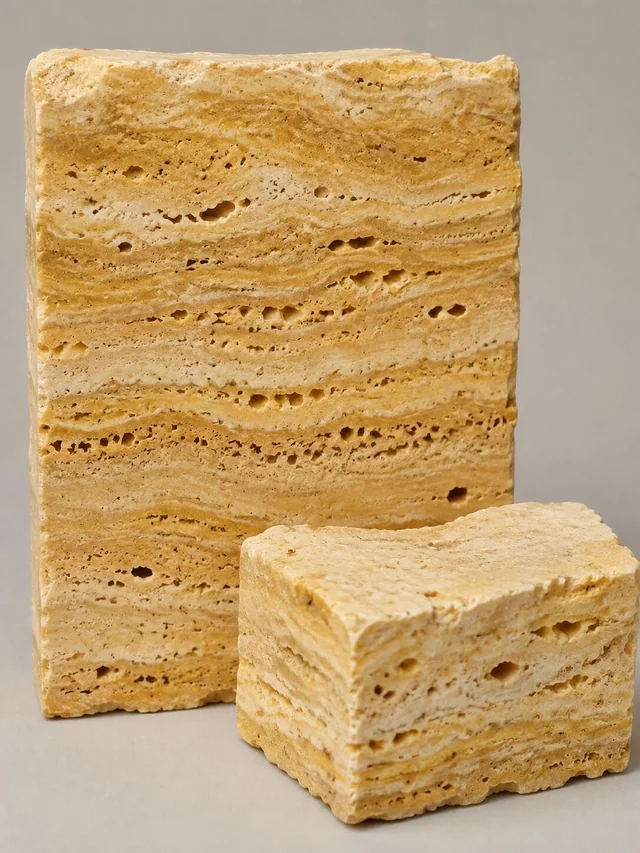
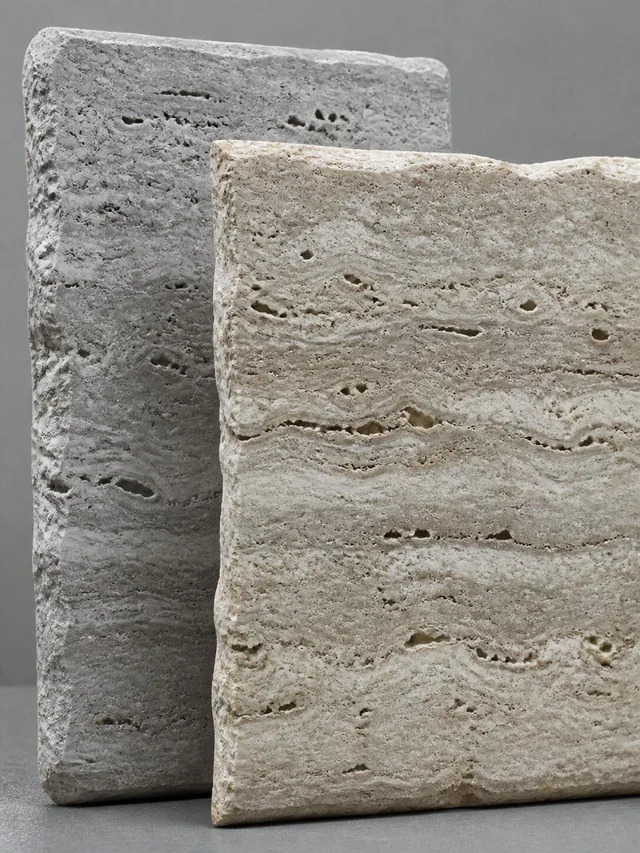
Travertine colour and texture references
These images were supplied to DeHong Stone with a colour introduction. They are used here as appearance references. Quarry origin, treatment, dimensions and production history have not been established from the images. Use them to explain a preference, then review the proposed physical sample.
Vein cut and cross cut: plan the pattern at object scale
Cutting direction changes the pattern revealed by a layered block. Vein-cut material is associated with linear bands; cross-cut, also called fleuri-cut, generally gives a cloudier or more mottled appearance. Neither label by itself means a better grade. The important design decision is how the pattern appears on the finished faces.
For a rectangular tray, mark the preferred direction of the bands on the drawing. For a display base, identify the top, front and sides: a coherent top view does not guarantee the same effect around an edge. A small coaster may capture only part of a broad band, so judging it from a full slab photograph can be misleading.
Ask for a proposed cutting layout or an object-size reference where pattern placement matters. For a coordinated set, decide whether the aim is a related family of appearances or closer visual matching. The acceptable range should be agreed before production, not after comparing finished pieces with a single idealised image.
Open pores, filling and the difference between texture and structure
Openings are characteristic of travertine, but the visible face is only part of the picture. The Natural Stone Institute explains that surface filling reaches accessible voids; enclosed internal cavities remain. Cementitious or resinous fillers may be used. A thin layer over a near-surface cavity can break and expose a new opening. Filling the face therefore does not make the material solid throughout. Read the Natural Stone Institute explanation of travertine voids.
For a small custom object, distinguish a decorative pore from a cavity that interrupts a rim, corner, support point or fixing. Ask to review the underside and edges as well as the top. Do not grade a stone solely by counting holes: the selected piece and its remaining structure need to suit the design.
| Choice | What it changes | What to agree |
|---|---|---|
| Unfilled surface | Retains an open, tactile appearance. | Which openings are acceptable, where contents touch the surface and how it will be cleaned. |
| Filled surface | Closes accessible openings and changes the visual continuity. | Fill material, colour, finish, repair acceptance and suitability for intended contact. |
| Impregnating treatment | May improve resistance to staining when compatible and correctly applied. | Product suitability, application, maintenance and project-specific verification. |
Filling and impregnating are different operations. A request for “sealed travertine” is too ambiguous to define both. Describe the desired appearance and exposure, and ask the supplier to state the proposed treatment in the sample record.
Honed, polished or textured: separate appearance from performance
A honed finish has a subdued, low-reflection appearance; a polished finish is more reflective. A textured treatment changes the tactile surface. Each should be reviewed together with pore treatment because two pieces described as “honed travertine” can still feel and look different.
For a custom travertine display base, compare the finish with the object being displayed and with the light falling across it. For a travertine valet tray, inspect the usable recess and the transitions where items will rest. A finish name does not establish resistance to scratches, slipping, oil or water.
Discuss an eased edge, radius or chamfer using a drawing and a sample. Thin rims, drilled areas and narrow bridges need individual review around the selected stone. There is no universal machining tolerance or minimum edge thickness promised by this guide. Agree functional dimensions and sample checks before accepting the design.
Water, oil and acids: three different questions
A stain involves a substance entering or discolouring the stone. Etching is chemical attack on a carbonate surface, often leaving a dull mark. They call for different prevention and care decisions. The Natural Stone Institute advises avoiding acidic cleaners on calcareous stone and notes that impregnators improve stain resistance rather than make stone stain-proof. Use an appropriate neutral stone cleaner, blot spills promptly and follow the treatment supplier’s instructions. See the Natural Stone Institute care guidance.
In a bathroom or perfume display, explain likely contact with water, cosmetics and cleaning products. A tray used beneath bottles has a different brief from a vessel expected to hold liquid. For food contact, heat exposure or prolonged wet use, ask for specific suitability review; the material name and photographs are not enough.
Use an offcut or agreed test sample to assess the proposed treatment and maintenance routine before applying them to a finished piece. Record the substance, exposure and observed result. A simple sample check should not be presented as a certification or a guarantee of lifetime performance. The separate guide to oil-staining risk on carbonate display surfaces explains how to frame that review.
How to specify a custom travertine object
A useful enquiry connects the appearance you like to the job the object must do. DeHong Stone is a China-based custom stone manufacturer. We assess small natural stone objects around customer ideas, drawings, references and material requirements. Website references are starting points for development, not a fixed stocked catalogue.
- Describe the use. State what the object will hold, touch or support, who handles it and how it is cleaned.
- Identify the visual direction. Share a reference number or image and describe colour, banding, pore treatment and finish separately.
- Mark the geometry. Include overall dimensions, recesses, wall or rim areas, holes, contact faces and critical fit requirements.
- Agree the sample range. Review variation across several representative pieces when consistency matters. The Natural Stone Institute recommends range samples because appearance and quality can vary even within one quarry. See its travertine selection guidance.
- Define acceptance. Record acceptable pores and fill, edge appearance, dimensions to check, any pads or liner, and requirements still needing verification.
- Include quantity and delivery details. These allow the material allocation, sampling plan and protective packing to be reviewed together.
Keep the approved sample, written specification and agreed range linked to the quotation. If the material or design changes, review the affected decisions again. Price, minimum order quantity and sampling time depend on the actual brief; no fixed figures are implied here.
Travertine questions, answered
Q: Is travertine marble or limestone?
A: Travertine is a sedimentary carbonate stone commonly described as a type of limestone. Marble has a different geological history involving metamorphism. A commercial name alone does not establish the identity or properties of a particular sample.
Q: Why does travertine have holes?
A: Voids are a characteristic of travertine formation. Some are visible at the surface and others remain inside the stone. Pore count alone does not establish quality; the location of cavities, remaining solid material and intended use need review.
Q: Is all travertine beige?
A: No. Travertine can show cream, ivory, beige, gold, grey, brown and red tones. Colour names describe appearance, not a uniform specification. Review a representative sample range for the proposed batch.
Q: What is the difference between vein-cut and cross-cut travertine?
A: Vein-cut references emphasise directional bands; cross-cut or fleuri-cut references typically show a cloudier pattern. They describe cutting and appearance, not a separate colour or an automatic quality grade. Agree the pattern on the actual object and its visible faces.
Q: Does filled or sealed travertine become waterproof?
A: No blanket waterproof claim follows from filling or sealing. Filling closes accessible openings; a compatible impregnator can improve resistance to staining. Neither establishes acid resistance, liquid containment or suitability for prolonged wet use.
Q: Can travertine be used for custom trays and display bases?
A: It can be considered for those designs, subject to the selected stone, geometry and intended contact. Review recesses, edges, support points, cleaning and any liner or pads on a sample before approving production.
Q: What should I send for a custom travertine enquiry?
A: Send the intended use, reference image or drawing, dimensions, preferred colour and pattern, fill and finish preferences, quantity and destination. Include expected liquid or cosmetic contact and packaging needs so the sample review can address them.
Sources and scope
General geology and stone-care references inform this guide; they are not certifications, endorsements or tests of DeHong Stone products. The colour brief and six images were supplied for this article. Material origin, performance and project suitability require separate confirmation.
Apply the guidance to your project
For a project-specific review, send your intended use, drawing or reference, dimensions, material preference, estimated quantity and delivery destination to DeHong Stone. The team can review which details need sample confirmation before quotation.
Website: www.dehongstone.com
Email: hefeng@dehongstone.com
WhatsApp: +86 139 8660 4493
General purchasing guidance is not a project quotation or a material test result. Confirm specifications, verification and terms for the selected sample.
Bring your drawing and project requirements.
Include your intended use, reference, dimensions, material preference and quantity. Agree the feasibility review and sample requirements in writing.