Why Does My Stone Tray Leave “a Powdery, Chalky Film” on My Hands?
TL;DR: A finished stone object should arrive with a clearly specified surface and an underside suitable for its intended placement. Powder on the hands and scratches on furniture need investigation, not a blanket explanation that stone is natural. Check whether the residue is loose production dust, packaging debris, treatment residue or a recurring material-related deposit. Specify cleaning, dry inspection, underside finish and compatible protection together. A pad can help separate surfaces, but it does not correct a dirty, unstable or badly finished base.
Published
Updated
Why the underside changes the whole experience
A tray can look beautiful from above and still disappoint at first touch. White dust transfers onto a dark sleeve. Grit appears inside the packaging. The buyer slides the object across a console and notices a scratch. What seemed like a decorative finishing issue has become a concern about the furniture beneath it.
For a boutique retailer, dust makes stock look unfinished. For a jewelry business, residue near packaging or delicate products is unwelcome. For a hotel, an awkward underside can increase cleaning difficulty and make housekeeping hesitant to move the item.
These outcomes deserve specific checks. Neither a styled top view nor the word “handmade” explains how the underside was prepared. The contact surface is part of the product's functional design, even when it is not intended to be seen.
Identify the source of the powder
Loose cutting or grinding residue is one possible explanation, but not the only one. Packaging can shed particles. A surface treatment can leave a film if incorrectly applied or not properly removed. Some white deposits involve mineral salts associated with moisture. Natural Stone Institute guidance discusses this latter condition as efflorescence. [3]
The appearance of white powder alone cannot identify its cause. Record whether it is present only at unpacking or reappears after cleaning. Check whether it transfers from the stone, the insert or both. Photograph the dry surface and packaging, and ask what finish and treatment were used.
If powder continues to return, seek assessment rather than repeatedly concealing it with oil or coating. Adding a new treatment before identifying the cause can change the appearance and complicate further diagnosis. A cleaning method suitable for loose production residue may not be suitable for every recurring deposit.
A visible underside detail
Supplied product photographs for discussing form, arrangement and visible appearance. Confirm stone identity, dimensions and suitability for your project through sample review; these references are not a stock catalogue or a customer delivery case.
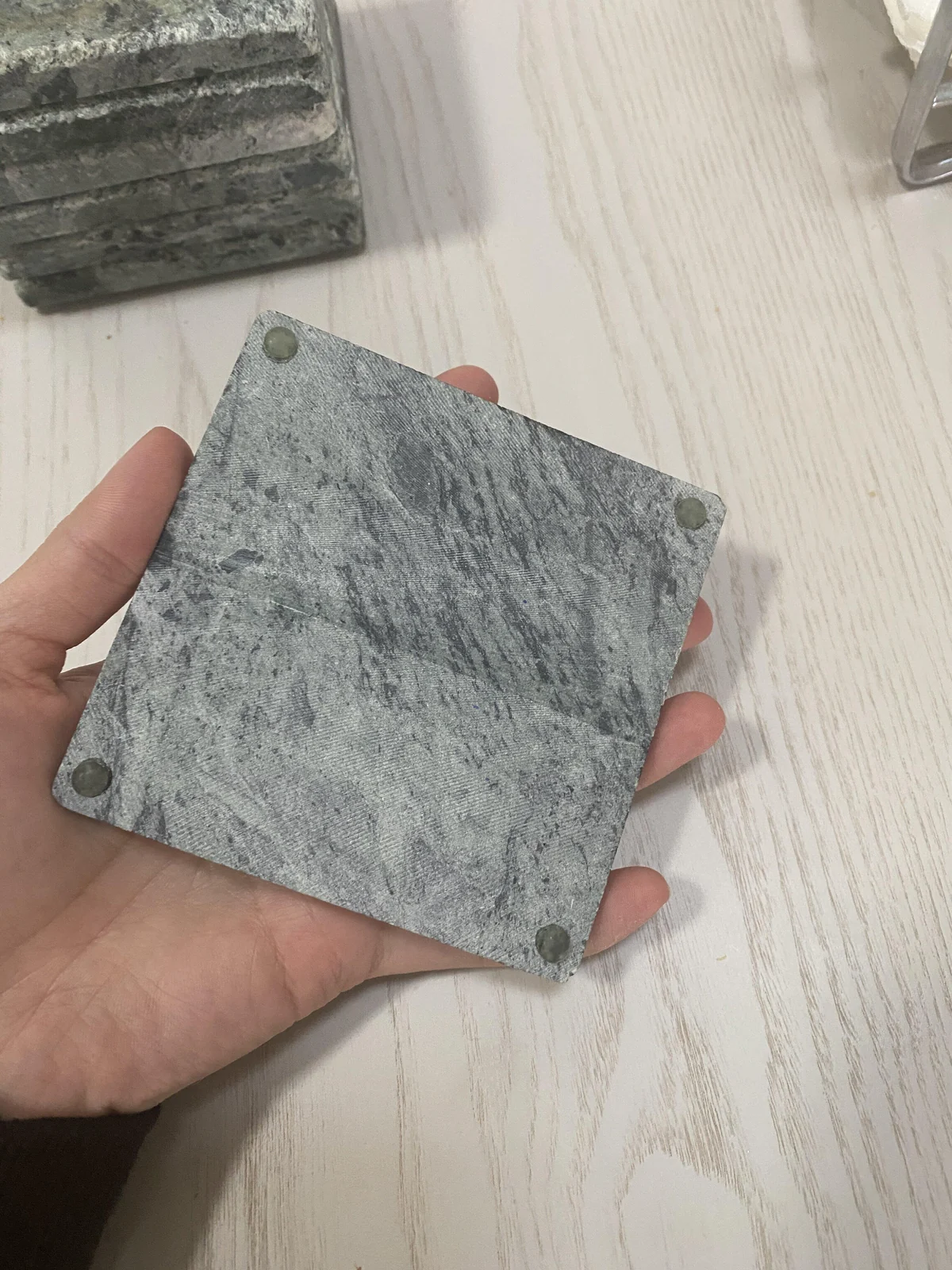
Specify clean, dry inspection as a finishing step
For a new product, agree on a final cleaning method compatible with its stone, filling, adhesive and surface treatment. Allow the object to dry as appropriate before inspection and packing. A wet photograph can conceal changes in sheen or temporarily deepen the appearance of the stone.
A practical workshop check can use a clean light and dark cloth on designated areas to look for transferable residue. This is an agreed visual housekeeping check, not a recognized certification or proof that every microscopic particle has been removed. Inspect recesses, grooves, drilled areas, engraved details and corners where debris can remain.
Check the packaging as well. A clean product placed into a dusty insert can arrive looking dirty. Keep abrasive particles away from finished surfaces and avoid wrapping materials that react with a proposed finish. The final inspection needs to consider the product and its immediate contact materials together.
Treat the base as a designed contact surface
An underside does not always need the same decorative polish as the top. It does need an agreed finish, controlled edges and appropriate support for the intended use. A deliberately textured base is different from an unspecified surface with loose grit or sharp projections.
Assess whether the object rocks on a known reference surface. Wobble can reflect the stone base, uneven pads or the supporting furniture; it should not automatically be blamed on one component. A heavy object concentrated on a few small contacts can also behave differently from one supported more broadly.
Do not drag the stone across furniture to test whether it scratches. Inspect and evaluate the intended interface using an inconspicuous area or an appropriate test surface with permission. For everyday handling, lift rather than slide, and keep both the underside and the furniture free of trapped grit.
Choose protection for the actual setting
Felt, cork and other suitable buffers may help separate stone from furniture, but they are not interchangeable. Consider thickness, compression, grip, moisture exposure, potential transfer and adhesive compatibility. A dry bedroom and a bathroom vanity can require different decisions.
Small pads may be discreet but must be positioned consistently and support the load. A full backing can create a different look and drying behavior. Any option can fail if it traps debris, detaches or interacts with the supporting finish. Evaluate the complete combination rather than promising universal scratch protection.
For a commercial project, identify the supporting surface: lacquered wood, glass, metal or another stone. Where practical, test a representative contact arrangement with the actual finish. Agree how worn or detached protection should be replaced, and whether the customer is expected to install it or receive it already fitted.
Compare the finishing specifications
| Specification | Vague listing | Clear functional requirement |
|---|---|---|
| Cleanliness | “Hand polished” | Dry surface checked for transferable residue |
| Underside | Not photographed | Finish and edges shown or described |
| Stability | Assumed from weight | Support arrangement checked for rocking |
| Protection | “Pads included” | Material, placement and intended environment stated |
| Packaging | Decorative appearance only | Clean contact materials assessed with the product |
| Maintenance | No instructions | Lift to move; inspect and clean contact areas |
Turn the complaint into an actionable brief
Use wording such as: “The object will sit on a finished wooden console. Please propose an underside finish and suitable protection, show the base, and confirm the final cleaning and dry inspection criteria. The delivered surface should not show visible loose grit or readily transferable production residue under the agreed check.”
Add whether the object is moved frequently, exposed to water or used around delicate merchandise. For a sample review, inspect top, sides, recess and underside before approving the whole item. A beautiful front-facing photograph should never be the only finishing reference for production.
If a delivered piece feels gritty, stop sliding it on valuable furniture. Separate the item from the surface, document the condition and contact the supplier for material-specific guidance. If furniture has been marked, assess that finish separately; a cleaner suitable for stone may be unsuitable for lacquer or wood.
Review what happens after the first week
Furniture protection is not only an unpacking detail. Ask how the object will be moved, cleaned and returned to its position. A tray lifted every day experiences a different routine from a display base left in place for months. Pads and backing should suit that routine as well as the initial appearance.
Check whether protection remains attached during normal handling, whether the item sits evenly and whether the contact area can be inspected. In a wet setting, consider how moisture beneath the object is detected and removed. A concealed underside is not a reason to leave its condition unmonitored.
For a sample evaluation, keep observations specific: residue transferred to the cloth, uneven support, loose particles or a lifting pad. Record when each observation occurs. This is more useful than calling a sample “rough” without identifying the area or the effect on use.
For repeat orders, retain the underside specification as well as the attractive top view. A change in pad thickness, placement, adhesive or base treatment can alter the experience even when the visible stone looks unchanged. Such details deserve the same attention as a logo or decorative edge.
Discussing finishing with DeHong Stone
DeHong Stone develops custom natural stone objects for wholesale and OEM requirements. When you request a tray, organizer or display base, include the surface it will stand on and whether it is used in a dry or wet environment. Explain whether staff or customers will move it regularly.
Ask to confirm the underside finish, any protective material and the final inspection method in the sample specification. Decorative top polishing and furniture protection are separate matters; neither should be left to an assumption based on product photography. If there are restrictions on adhesives or backing materials, state them early.
A useful inquiry is: “This object will be placed on lacquered furniture and moved during cleaning. Please propose a suitable base arrangement and show the underside of the sample. We need to assess cleanliness, stability and contact protection before production.” Include dimensions, quantity and your stone preference.
The goal is a finished object that feels considered from every side. Specific cleaning, backing and inspection arrangements need agreement for the actual design and use. A protective pad is one possible component of that solution, not a universal guarantee against damage.
FAQ
FAQ 1: Does white powder always mean poor washing?
Answer: No. Loose production dust is one possibility, but packaging debris, treatment residue and recurring mineral deposits need different assessments.
FAQ 2: Must the underside be mirror polished?
Answer: Not necessarily. The correct requirement is a suitable, stable, clean contact arrangement with controlled edges. Decorative polish alone does not guarantee furniture protection.
FAQ 3: Will felt guarantee that furniture cannot be scratched?
Answer: No. Grit, pad wear, detached adhesive and the supporting finish can all affect the result. Inspect the interface and lift the object when moving it.
FAQ 4: Can I solve the problem by applying oil?
Answer: Do not assume so. Oil can change appearance, affect the surface or interfere with subsequent treatment. Identify the residue and follow stone-specific advice first.
FAQ 5: How should I specify a DeHong Stone project?
Answer: Through www.dehongstone.com, share the design, dimensions, quantity, supporting surface and dry or wet use conditions. Ask to confirm the proposed underside, protection and inspection method in the sample specification. Those details should be agreed for the actual project, not inferred from general product photographs.
Technical references
[3] Natural Stone Institute — Care & Cleaning of Natural Stone
For a tray resting on furniture, use the Watch Cove tray design reference to identify supporting surfaces, then agree the underside finish, cleaning and protective pads on the actual sample.
Apply the guidance to your project
For a project-specific review, send your intended use, drawing or reference, dimensions, material preference, estimated quantity and delivery destination to DeHong Stone. The team can review which details need sample confirmation before quotation.
Website: www.dehongstone.com
Email: hefeng@dehongstone.com
WhatsApp: +86 139 8660 4493
General purchasing guidance is not a project quotation or a material test result. Confirm specifications, verification and terms for the selected sample.
Bring your drawing and project requirements.
Include your intended use, reference, dimensions, material preference and quantity. Agree the feasibility review and sample requirements in writing.