Why Does My Marble Tray Look “Nothing Like What Was Advertised”?
TL;DR: Natural variation is part of real stone, but an unexpected appearance should not be dismissed with “every piece is unique.” A better buying process separates the design you can specify from the geological variation you need to approve. Use a range of real samples, agree on acceptable color and veining, review the finish under consistent lighting, and confirm what the approval actually covers. A rendering can communicate a concept; it cannot establish the appearance of material that has not been selected.
Published
Updated
The problem behind the disappointment
Imagine a cream-colored tray shown beside pale linen and a clear perfume bottle. Its quiet surface is central to the composition. The delivered tray has the same outline, yet a dark vein crosses the center. Nothing is necessarily wrong with the stone itself, but the customer has received a different visual experience.
For a retailer, that difference can undermine product photography. For a jewelry brand, strong movement can compete with a delicate ring. For an interior designer ordering several accessories, inconsistent undertones can disrupt the whole arrangement. The practical question is therefore not whether natural stone varies. It is how much variation the project can accommodate, and where that variation matters.
A photograph also records lighting, exposure, background and finish. A warm studio image may make a neutral stone appear creamier. A polished surface may reflect its surroundings. These effects do not prove deliberate deception, but they explain why a single attractive image is an incomplete purchasing specification.
Start with the visual job of the object
Before choosing a stone name, describe what the object must do visually. Should a perfume base remain quiet behind packaging? Should a bookend become the focal point? Does a tray need an uninterrupted central area for a logo or display arrangement?
Write those priorities in plain language: a light warm background, restrained dark markings, no prominent contrasting vein through the main display area, and a consistent honed appearance. These are project preferences to discuss, not universal quality grades. A dramatic vein can be desirable in one collection and unacceptable in another.
Define which faces matter. The top, front edge and inside of a tray may be visible every day, while its underside is rarely seen. Asking for the same appearance on every concealed face can add selection difficulty without improving the customer experience. Conversely, ignoring the front edge can produce an obvious mismatch in a retail display.
Veining across visible pieces
Supplied product photographs for discussing form, arrangement and visible appearance. Confirm stone identity, dimensions and suitability for your project through sample review; these references are not a stock catalogue or a customer delivery case.
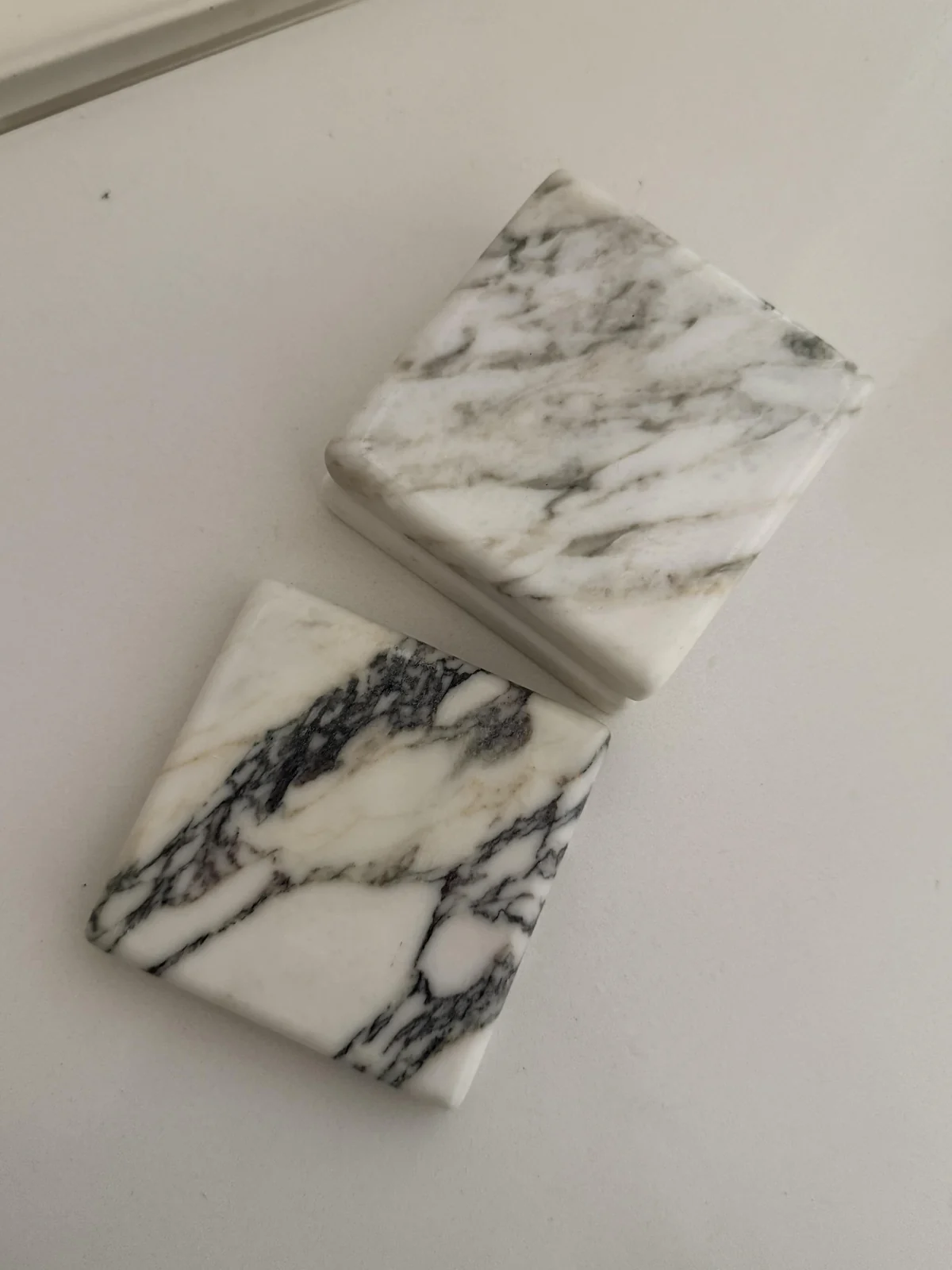
Approve a range, rather than an ideal photograph
A useful appearance reference includes several real pieces showing the proposed range. Include a quieter example, a typical example and a more expressive example. Label them clearly and ask which are acceptable. Do not quietly place an unacceptable sample in the group and assume the buyer understands the distinction.
A small chip sample helps assess color and finish, but it cannot show how a broad vein will cross a finished tray. For a small custom object, a finished sample or a marked cutting layout can provide more relevant information. If a particular piece must be selected individually, agree on that service before pricing or production.
For wholesale orders, individual approval of every item may be impractical. An agreed range, batch identification and a sampling plan can provide a more workable route. State how pieces outside the approved range will be handled. Also state that an approved sample does not promise a repeated geological pattern across every unit.
Photograph the material honestly
Ask for ordinary photographs of the proposed stone under neutral, consistent lighting, alongside close views of the finished surface. A reference card and a fixed camera setup can help comparison, but screens still differ. Color-critical projects benefit from physical approval.
Keep design renderings, material references and finished-product photographs clearly labeled. A design rendering should not be presented as evidence of the exact piece being supplied. When creating several angles, the rim, recess, edge profile and proportions should remain consistent; those are design attributes, not natural variation.
A useful approval record pairs photographs with a drawing, finish description, date and sample identifier. This makes it possible to distinguish an appearance disagreement from a change in geometry. It also gives a repeat order a meaningful starting point, even when a new stone batch requires fresh approval.
A more useful comparison
| Decision | One promotional image | A defined appearance process |
|---|---|---|
| Color | Inferred from styling | Physical reference and agreed undertone |
| Veining | Assumed to repeat | Acceptable range and visible-face priorities |
| Finish | Described as “smooth” | Named finish with an approved sample |
| Geometry | Judged from an angle | Drawing plus consistent views |
| Repeat orders | Expected to match automatically | New batch checked against retained references |
Turn preferences into an order brief
A practical brief can say: “This base supports a light-colored fragrance bottle. Please propose natural stone with a warm light background and restrained movement. Show the likely appearance range, identify any surface filling or treatment, and provide a finished sample for approval before the production specification is finalized.”
That wording communicates the outcome without demanding identical natural patterns. Add dimensions, quantity, visible faces, intended lighting and any unacceptable features. If an exact match to an existing interior is essential, supply the actual reference rather than a cropped social-media image.
Avoid approving only the most beautiful sample. Ask whether the selected appearance is representative of the available material and what happens when the next batch differs. A good specification protects the buyer from an unwanted surprise while leaving room for the character that made natural stone attractive in the first place.
A practical example: a coordinated fragrance collection
Consider a brand developing a tray and two small bottle bases for the same display. The pieces do not need matching veins, but they need to read as one collection. Begin with shared background tone, finish and level of visual movement. Then decide whether a dramatic feature is acceptable on the tray but distracting beneath the bottle label.
Ask the supplier to present the proposed group together, as well as individually. This reveals relationships that separate close-ups hide. A photograph of a quiet tray cannot approve a strongly patterned batch of bases by implication. If the collection will be replenished over time, retain references for the group and review new material against them.
A useful sample review records decisions rather than impressions. Write “acceptable warm undertone; avoid broad dark bands across the bottle area” instead of “looks premium.” If a feature is unacceptable, show it and explain why. The supplier can then assess whether selection is feasible and what it means for yield, price and timing.
This approach does not eliminate natural character. It makes the collection's visual priorities understandable to both parties and creates a basis for discussing alternatives before production.
Discussing a custom stone project with DeHong Stone
DeHong Stone works on custom natural stone objects for wholesale and OEM projects. A useful starting point is your reference image or drawing, intended use, dimensions, quantity and preferred stone appearance. For fragrance and jewelry displays, include the item that the stone needs to support or visually complement.
Treat material selection, sample approval and appearance inspection as items to confirm in the project quotation. Do not assume that a general website image represents a reserved slab or an individually selected finished piece. If you require tighter selection, explain the requirement early so feasibility and any additional work can be discussed.
For an initial inquiry, you can write: “We are developing a coordinated collection for retail display. Please review our drawing and advise on suitable natural stone options, the proposed appearance range and the sample process.” This keeps the conversation focused on what can be assessed, without asking either side to promise identical natural patterns.
The most helpful outcome is an agreed specification: the material range, visible faces, geometry, finish and approval method. Once those decisions are clear, a beautiful reference image becomes a shared direction rather than an ambiguous guarantee.
FAQ
FAQ 1: Can every marble tray have exactly the same veins?
Answer: Natural stone does not provide a printed, repeatable pattern. Related pieces may coordinate, but exact repetition should not be promised. Specify a visual range or discuss individually selected pieces when the project requires tighter control.
FAQ 2: Is a dark vein a defect?
Answer: Not automatically. A contrasting vein may be normal mineral variation. Whether it suits the order depends on the agreed appearance criteria. Structural concerns require separate assessment and cannot be resolved by calling every line “natural.”
FAQ 3: Is an AI rendering enough to approve a custom object?
Answer: It can help discuss shape and styling, but it does not verify available stone, machining details or a finished surface. Use drawings and real samples for those approvals.
FAQ 4: What should I do if the delivered color seems wrong?
Answer: Compare the dry product with the retained sample under similar lighting. Photograph the visible faces and identify the specific difference. Refer to the approved range and order terms rather than relying on the original mood image alone.
FAQ 5: How can I start a DeHong Stone project?
Answer: Share your reference image or drawing, dimensions, quantity and appearance priorities at www.dehongstone.com. Ask for a project-specific discussion of material selection and sample requirements before agreeing to production. Exact selection, sampling and inspection arrangements should be confirmed in the quotation.
Use the layout of the Duo Valet tray design reference to discuss where veins may cross dividers and recesses, then confirm the appearance with the selected physical sample.
Apply the guidance to your project
For a project-specific review, send your intended use, drawing or reference, dimensions, material preference, estimated quantity and delivery destination to DeHong Stone. The team can review which details need sample confirmation before quotation.
Website: www.dehongstone.com
Email: hefeng@dehongstone.com
WhatsApp: +86 139 8660 4493
General purchasing guidance is not a project quotation or a material test result. Confirm specifications, verification and terms for the selected sample.
Bring your drawing and project requirements.
Include your intended use, reference, dimensions, material preference and quantity. Agree the feasibility review and sample requirements in writing.