Why Does My Marble Tray Look “So Much Clunkier” in Person?
TL;DR: Minimalism is a relationship between the object, its details and its setting; it is not a promise of the thinnest possible stone. To avoid a bulky surprise, approve external dimensions, usable space, visible edge profiles, recess depth and approximate weight together. Review a full-scale outline and a finished prototype beside the actual item it will hold. Any proposed production change should return to the buyer for approval rather than being hidden behind a familiar camera angle.
Published
Updated
When a beautiful close-up becomes an awkward object
A jewelry dish looks delicate online. Its edge appears slender, and the camera leaves little background for comparison. On a narrow bedside table, the delivered dish dominates the surface. The listed width may even be correct, yet the thickness, rim and overall mass create an entirely different impression.
For a fragrance brand, a base can overpower the bottle instead of supporting it. For a boutique retailer, a small platform can occupy too much counter space. For an interior designer, an object may fit physically but still look wrong beside a lamp, mirror or cabinet.
This is not always a manufacturing error. Sometimes the listing never communicated scale. Sometimes the rendering implied an impractical profile. Sometimes the maker changed a detail without clearly explaining its visual effect. A useful specification addresses all three possibilities instead of assuming that a single dimension resolves them.
Specify the space you will use, not only the outline
External length and width tell you whether an object fits on a surface. They do not tell you whether a bottle fits inside its recess. A wide rim can consume much of a small tray. Curved corners can reduce the effective area further, particularly for rectangular packaging.
Record the internal clear area, recess depth, rim width, total height and the supporting footprint where relevant. For a display base, include the bottle's footprint and desired surrounding space. For a jewelry dish, consider how someone reaches inside and lifts a small item without catching it against the edge.
Use the actual objects when possible. An arrangement that looks balanced with one narrow bottle may feel crowded with two larger containers. If the product family will change, identify the size range it needs to accommodate rather than designing around one unusually convenient prop.
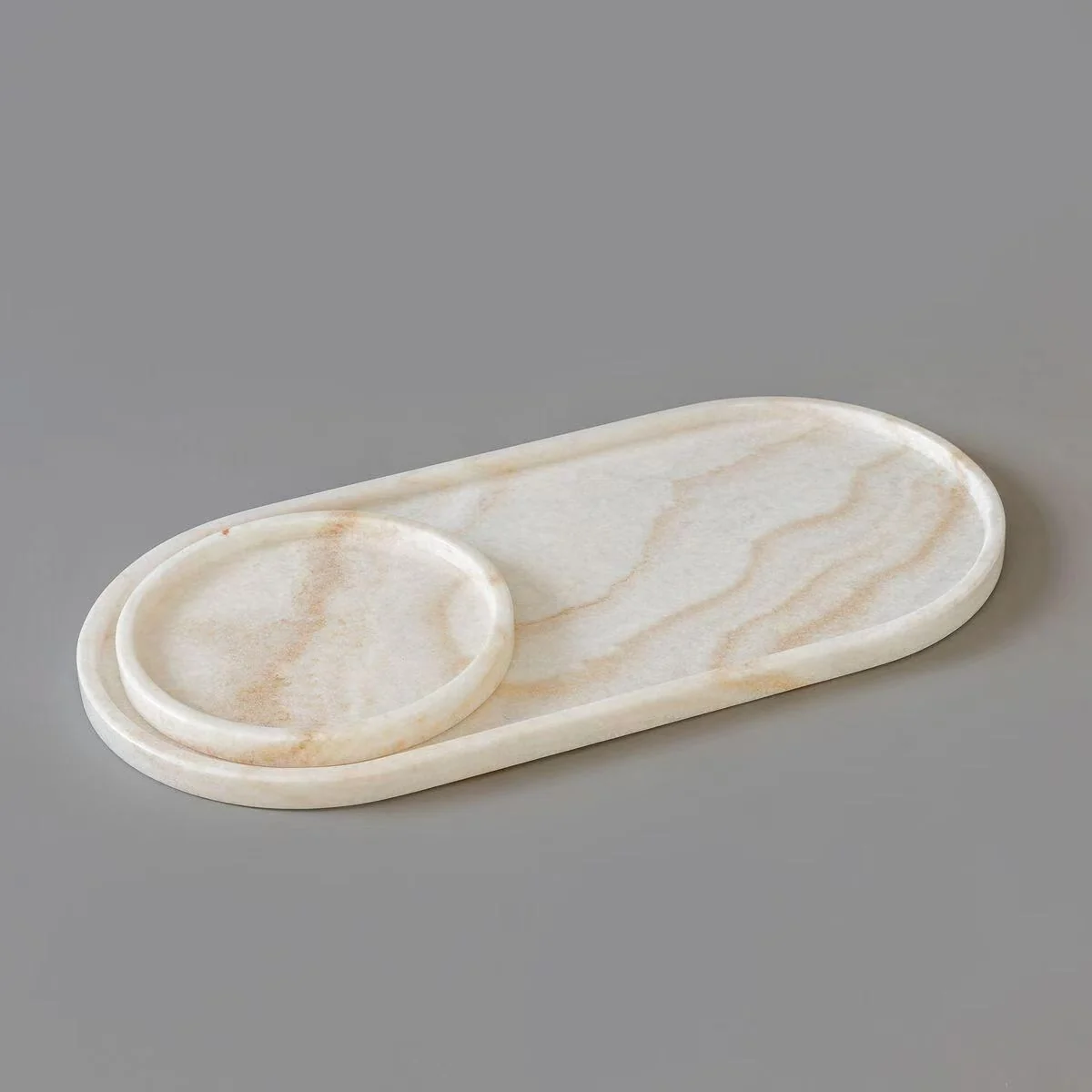
Tray and dish proportion references
Supplied product photographs for discussing form, arrangement and visible appearance. Confirm stone identity, dimensions and suitability for your project through sample review; these references are not a stock catalogue or a customer delivery case.
Separate apparent thickness from total thickness
A tray's visible edge is only one part of its section. A recess, chamfer or underside detail can change how heavy it appears, but these choices also affect fabrication, support and cleaning. They must be evaluated in the selected stone rather than approved only as an attractive sketch.
Ask for a section drawing through the important detail. A plan view cannot reveal whether the inner wall is vertical, sloping or curved. Those differences change both the visual character and usable space. Two objects with the same external measurements can therefore perform very differently.
Do not set a universal minimum thickness from a photograph. The appropriate geometry depends on the material, span, natural features, recess and intended use. A refined design may use balanced proportions and a controlled edge rather than an extremely thin lip. The aim is a coherent object, not simply less material.
Check scale before investing in a finished sample
A paper outline placed on the real counter quickly reveals footprint problems. A simple full-size volume model can help judge total height and bulk, although it does not reproduce stone weight, texture or structural performance. This is a design check, not a replacement for the actual product.
Then assess a finished prototype beside the intended bottle, jewelry packaging or furniture. View it from normal standing and seated positions, not only from the overhead angle used in a product image. Check whether the proportions still work once the object carries its intended contents.
Ask for approximate net weight as a separate specification, with the acceptable range agreed for the project. Weight affects lifting, cleaning, shelf suitability and delivery cost. It should not be inferred from appearance, nor confused with packed shipping weight.
Photograph the approved object with useful references
Include an uncluttered overall view with a scale reference whose dimensions are known. Photograph the top, side and important section details. A hand can communicate size, but its dimensions vary; a dimensioned drawing remains the clearer technical reference.
Keep the geometry consistent across marketing images. The same product should not appear with a shallow sloping recess in one image and a deep vertical wall in another. Natural veins may vary, but the rim height and design should not drift between views.
A staged image can still be beautiful while communicating scale honestly. It should show how much space the piece occupies and how the supported object relates to it. Detailed photographs then explain the finish rather than substituting for the overall view.
Compare the approval methods
| Approval item | Appearance-only approach | Scale-aware approach |
|---|---|---|
| Footprint | Width listed without context | Full-size outline in the intended setting |
| Usable area | Assumed from external size | Internal clear dimensions confirmed |
| Edge | Inferred from one photograph | Section drawing and prototype |
| Weight | Described as “solid” or “premium” | Approximate net weight and handling review |
| Changes | Maker adjusts details silently | Revised drawing or sample approved |
| Marketing | Close-ups define expectations | Overall views plus consistent details |
Write a brief that preserves the intended character
Try this: “The base should support the bottle without becoming the visual focal point. Please confirm external and usable dimensions, total height, edge section and approximate net weight. If the proposed profile is unsuitable for the selected stone, show the revised design before producing the final sample.”
Add the setting, photographs of nearby objects and the important viewing angle. For a hotel vanity, include available counter space. For a retail display, include the shelf footprint and the products placed together. For repeat orders, retain the approved drawing and prototype reference rather than relying on the marketing image.
Changes in material availability can require a fresh review, but they do not justify an unnoticed change in proportions. If a design must become thicker, explain why and compare alternatives. Buyers can then choose knowingly between appearance, handling, manufacturability and cost.
Keep the design decision visible through production
A useful approval file brings together the drawing, sample photographs, net weight reference and the dimensions of the supported object. Give it a revision identifier. If the rim, recess or underside changes, update that record rather than leaving contradictory images in circulation.
This matters when several people are involved. A designer may approve appearance, a purchasing team may approve cost and a factory may assess manufacturability. Without a shared reference, each person can reasonably assume that a different version is final. A concise revision record connects those decisions.
For a coordinated collection, compare pieces together. A larger tray and a small base can share the same design language without using an identical rim width. Scaling every detail by the same factor may not preserve the original character or usability. Review each size on its own and within the group.
Keep the final photography tied to the approved geometry. If marketing images are created before the production sample exists, label them appropriately during development and replace or verify them before publication. The customer should not discover a necessary design revision only after opening the package.
Discussing proportion with DeHong Stone
For DeHong Stone custom projects, provide the intended setting and supported object alongside your design reference. A fragrance base, jewelry display and bathroom organizer may share a material but require different clear areas, edge details and handling considerations.
Ask for the important dimensions and section details to be included in the sample specification. If your reference implies an unusually thin edge or deep recess, invite a feasibility discussion before agreeing on the appearance. Any suggested change should be visible in the revised drawing or sample.
You can write: “We want a compact natural stone object with a restrained profile. Here are the bottle dimensions and the available counter space. Please review the geometry and flag details that need revision before final sampling.” Add quantity and preferred stone so the proposal can address the actual project.
The aim is to preserve the visual intention while making a practical product. Drawing review, sample preparation and production tolerances should be confirmed for the order; a website image is a starting point for that conversation, not a complete manufacturing specification.
FAQ
FAQ 1: Is a heavier stone object automatically better quality?
Answer: No. Weight may contribute to a desired sense of solidity, but it does not establish good proportion, accurate workmanship or suitability for the intended surface.
FAQ 2: Can a stone tray be both refined and practical?
Answer: Yes, but the result needs material-specific design and sample approval. A visually quiet edge and balanced footprint may matter more than making every section extremely thin.
FAQ 3: Why are internal dimensions necessary?
Answer: Rims, slopes and rounded corners reduce usable space. External dimensions alone cannot confirm that a bottle, box or accessory fits.
FAQ 4: Is a full-size model enough to approve production?
Answer: No. It helps evaluate volume and placement. A finished stone prototype is needed to assess the actual material, surface, handling and details.
FAQ 5: How can DeHong Stone assess a custom design?
Answer: Send a drawing or reference image, dimensions of the objects being displayed, available space and quantity through www.dehongstone.com. Request a project-specific review of geometry, material and sampling. Final dimensions and any production changes should be agreed in writing.
Compare the usable layout of the Hotel Tile design reference with your intended objects, and mark the outside dimensions, recess depths and edge thicknesses on your project drawing.
Apply the guidance to your project
For a project-specific review, send your intended use, drawing or reference, dimensions, material preference, estimated quantity and delivery destination to DeHong Stone. The team can review which details need sample confirmation before quotation.
Website: www.dehongstone.com
Email: hefeng@dehongstone.com
WhatsApp: +86 139 8660 4493
General purchasing guidance is not a project quotation or a material test result. Confirm specifications, verification and terms for the selected sample.
Bring your drawing and project requirements.
Include your intended use, reference, dimensions, material preference and quantity. Agree the feasibility review and sample requirements in writing.