Marble Jewelry Trays Wholesale: A Buying Guide for Retail and Brand Displays
TL;DR: For wholesale marble jewelry trays, evaluate how the stone supports the jewelry, not only how the empty tray looks. Confirm the clear interior area, contrast, edge treatment, handling and base protection. A household catchall, a shop display and a branded gift have different requirements. DeHong Stone reviews custom natural stone tray projects by design, stone, dimensions and quantity, with samples and commercial details confirmed for each order.
Published
Updated
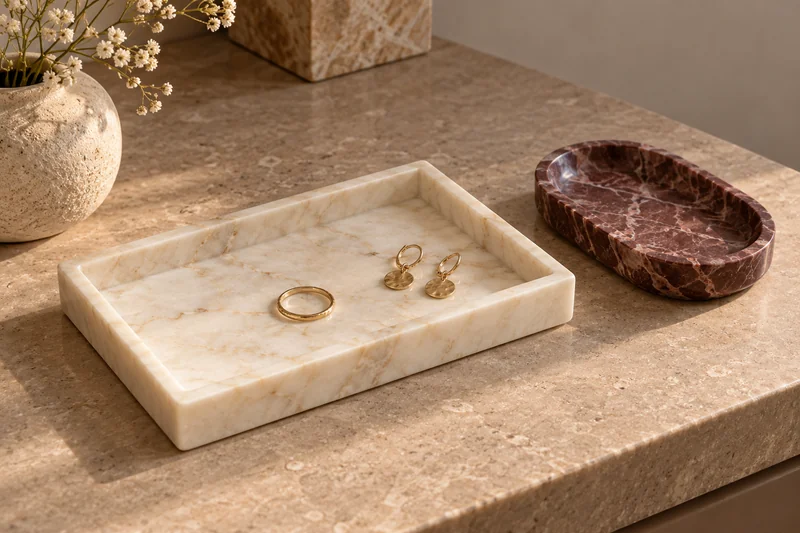
Start with the jewelry and the display task
A ring, a fine chain and a boxed item occupy space differently. Send the approximate dimensions of the pieces being displayed and explain whether they sit individually or in groups. If packaging must fit inside the tray, include the box rather than measuring only the jewelry.
A retail counter also has practical constraints. Staff need to lift and replace items comfortably, and the tray may need to move between storage and display. A piece that photographs beautifully can be awkward during a customer presentation if its rim is too high or its usable area too small.
For a homeware collection, the tray may instead be sold as a catchall. Then handling, presentation and clear care information become part of the customer experience. Decide which use is primary before choosing a shape or writing product descriptions.
Choose contrast before choosing a fashionable color
Light marble can provide a quiet background for some jewelry, while a darker stone can create a different contrast. Neither choice is universally best. Examine the actual jewelry against the proposed material and finish under lighting similar to the intended display.
Strong veins may compete with small details. In another arrangement, those veins may be the reason the tray is desirable. Define the visual priority rather than treating all expressive stone as a problem. It helps to identify an important central area where distracting movement would be unwelcome.
Surface reflection matters too. A more reflective finish can introduce highlights around polished metal; a softer-looking finish may suit a restrained composition. Review a real sample, because a digital image cannot fully communicate reflected light or how the combination feels in person.
Confirm usable area and access
Specify external dimensions and internal clear space separately. Add rim width, total height, recess depth and the internal corner form. Rounded corners and sloping walls can reduce the area available for a rectangular box even when the headline measurements look generous.
Consider how a customer or staff member retrieves a small ring. A deep recess may change access, while an overly broad rim can take space away from the intended display. The right balance depends on the objects and the role of the tray.
For several sizes, compare the collection together. A small ring dish and a larger counter tray need not share every proportion to look related. Keep a shared material and finish direction, then assess the edge and recess at each scale rather than making every detail an automatic enlargement.
Specify the contact surfaces
Do not assume that a stone tray is an appropriate surface for dragging delicate jewelry across it. The finish and contact arrangement should be evaluated with the items intended for use. Lift pieces when handling them and keep the surface free of abrasive particles.
The underside matters for the counter beneath the tray. Agree on its finish and any protective material, including placement and suitability for the supporting surface. A pad does not remove the need to keep grit out of the interface or to lift a heavy object when moving it.
For a branded presentation, discuss whether a removable liner or insert is needed. That changes the visual result, internal dimensions and cleaning routine, so it should be considered during design. Such components require separate suitability and supply confirmation, not an assumption that every natural stone tray includes them.
Compare the three common buying situations
| Requirement | Retail jewelry display | Homeware tray range | Brand gift |
|---|---|---|---|
| Primary fit | Actual jewelry and counter use | Consumer handling and storage | Item, presentation and packaging |
| Appearance | Complement the displayed pieces | Coordinate a collection | Match the intended brand direction |
| Branding | Discuss discreet placement | Product or packaging branding | Artwork and presentation review |
| Packing | Storage and delivery to the shop | Possible individual reshipment | Presentation plus transport protection |
| Approval | Review with actual merchandise | Finished sample and care information | Complete presentation sample where agreed |
One tray can serve more than one role, but the order should identify which requirements are essential. A gift presentation requirement should not be discovered only after the stone sample has been approved.
Make the sample review specific
Review the sample with representative jewelry and, where relevant, packaging. Check the appearance from normal counter positions as well as from above. Record whether the main display area, access and overall scale suit the intended arrangement.
Inspect edges and recesses, then assess the underside and the way the tray sits on a suitable reference surface. If the item rocks, investigate the contact arrangement rather than assuming weight makes it stable. Keep the sample and drawing references together.
For bulk production, clarify how stone variation will be judged. Exact veining is not a repeatable printed design. If the material palette is central to the brand, approve a realistic range and discuss selection for visible faces. Repeat orders should be checked against those retained references.
Ask for a quotation that fits the program
Provide quantities per size and stone, not just the number of stores. Explain whether every location receives the same set or a mix. If replenishment is expected, describe that requirement without assuming future material can be reserved indefinitely.
Share branding artwork, packing needs, destination and any planned onward delivery. Ask what is included in the proposed unit price and what is separate. Product, sample development, packaging and transport should be understandable enough to compare offers on the same basis.
Do not use a single online photo to specify all details. An inquiry supported by a simple drawing and the dimensions of the jewelry or packaging often establishes the task more effectively. Where details remain open, ask for options and identify what the sample needs to resolve.
Discuss a natural marble tray project with DeHong Stone
DeHong Stone focuses on small natural stone objects for wholesale and customization. Send your jewelry display or retail tray brief at www.dehongstone.com with the intended use, reference, dimensions, quantity and preferred appearance. This is a custom-project conversation, not a promise of a fixed stock collection.
Around 50 pieces can be an initial quantity to discuss for a suitable design. Material selection, mixed sizes, branding and packing affect the proposal. Samples are discussed on FCA terms with full prepayment; small production orders on FCA terms with a 30% deposit and balance before dispatch. Final terms, named place and timing require written confirmation.
FAQ
FAQ 1: Are jewelry trays the same as marble-base necklace stands?
Answer: No. A stone tray is different from a metal display stand with a stone base. Specify which product you need so the inquiry stays focused on the intended object.
FAQ 2: Can a wholesale tray be made in a custom shape?
Answer: Provide the outline, dimensions and use. The selected stone, edge details and quantity need assessment before feasibility and sample arrangements can be confirmed.
FAQ 3: Should the tray match the jewelry color?
Answer: Not necessarily. Contrast, reflections and visual movement all matter. Review actual merchandise on a representative finished sample under relevant lighting.
FAQ 4: Can I add branding without covering the display area?
Answer: Discuss the underside, edge or packaging as possible locations. Suitability depends on the artwork and design; confirm the method and appearance before production.
FAQ 5: Can I use the same tray for cosmetics as well?
Answer: Do not infer that from the shape. Explain likely contact with liquids or cosmetics and confirm the material, finish, care and any sample evaluation required for that use.
Apply the guidance to your project
For a project-specific review, send your intended use, drawing or reference, dimensions, material preference, estimated quantity and delivery destination to DeHong Stone. The team can review which details need sample confirmation before quotation.
Website: www.dehongstone.com
Email: hefeng@dehongstone.com
WhatsApp: +86 139 8660 4493
General purchasing guidance is not a project quotation or a material test result. Confirm specifications, verification and terms for the selected sample.
Bring your drawing and project requirements.
Include your intended use, reference, dimensions, material preference and quantity. Agree the feasibility review and sample requirements in writing.