Custom Marble Coaster Sets for Hotels: A Practical Specification Guide
Specify custom marble coaster sets around the hotel’s actual drinkware, furniture and cleaning routine. Record cup-base dimensions, usable coaster area, stone thickness, underside backing, logo position and set composition. Then approve a complete sample through drink service, cleaning, drying and storage. A photograph alone cannot establish whether a coaster fits the largest glass, separates easily from a stack or works with the hotel’s cleaning products.
Published
Updated
Start with the drinkware and service location
A bedside water glass, a lounge tumbler and a breakfast mug may need different coaster decisions. List each intended vessel, including its base shape, contact ring, filled weight and service location. Record the furniture finish beneath it and whether staff carry the coaster on a tray or place it directly on a table.
For a bespoke marble coaster set for hotel use, agree what “one set” means: a guestroom pair, several lounge pieces, or coasters supplied with a holder. State quantities by component, including spare single pieces. This prevents a request for “sets” from concealing different room layouts or replenishment needs.
Two commercial examples illustrate useful specification language. Crate & Barrel’s Marble Coasters, Set of 4 identifies foam feet and damp-cloth cleaning. John Lewis’s Round Marble Coasters & Gold Holder identifies a five-coaster set, a stainless-steel holder and a 10.5 cm coaster diameter. These are product-format references, not evidence of hotel purchasing demand or DeHong stock specifications.
Specify the usable surface before the outside dimension
Measure the cup base
Measure the widest part of the base that must sit securely on the coaster. Include a projecting foot or irregular outline. Do not substitute the glass rim diameter. For rectangular or asymmetric drinkware, record both footprint dimensions and orientation.
Draw the usable flat area separately from the outside edge. A bevel, rounded border or recessed feature can reduce the area available to support the vessel. Identify the intended cup zone on the drawing so branding and decorative details can be reviewed against it.
For example, a hypothetical hotel has a largest glass base measuring 94 mm across. It might compare 100 mm and 110 mm round samples. With a fully flat face, those leave nominal margins of 3 mm and 8 mm per side when centred. These are illustrative design choices, not recommended universal sizes or manufacturing tolerances. Check off-centre placement and actual service handling before choosing.
Define the complete height
Specify stone thickness and overall height including backing. Check how the complete coaster feels when lifted, how it meets a tray rim and whether the edge catches a cleaning cloth. Do not approve thickness from the stone alone if pads will be added later.
Record agreed dimensional acceptance criteria on the drawing. Use the CAD-to-prototype tolerance guide for that separate discussion; a commercial coaster’s published dimensions do not establish achievable tolerances for a new design.
Separate condensation handling from stain expectations
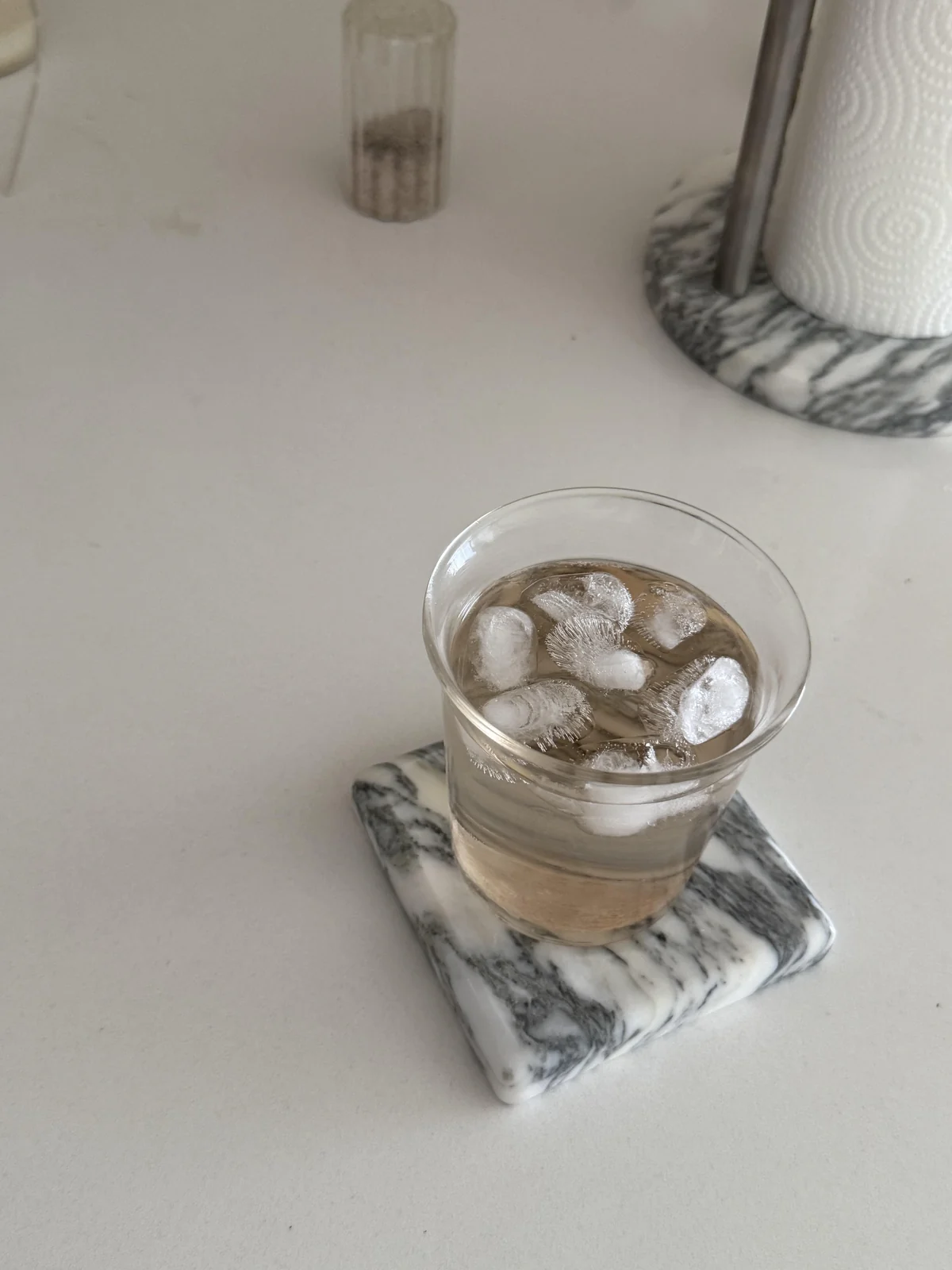
Write down the intended outcome for a cold drink: where droplets collect, whether liquid reaches the furniture and how staff dry the coaster between uses. Do not assume a marble coaster will absorb every drop. Compare complete samples with the actual chilled glasses under representative room conditions, then inspect the top, edge and underside.
A coloured stain and an etched patch need different attention. Acidic spills can etch marble, while wine and oil can also stain it; an impregnating sealer does not prevent acid etching. These distinctions are explained in Use Natural Stone’s marble-care guidance.
Describe the proposed finish and any treatment by product and application instructions. The Natural Stone Institute explains that impregnators can improve stain resistance without eliminating staining. Agree acceptable appearance after the sample trial rather than promising an unchanged surface. For a separate discussion of oily contact, see the honed-marble oil-stain guide.
Coaster backing, stacking and use references
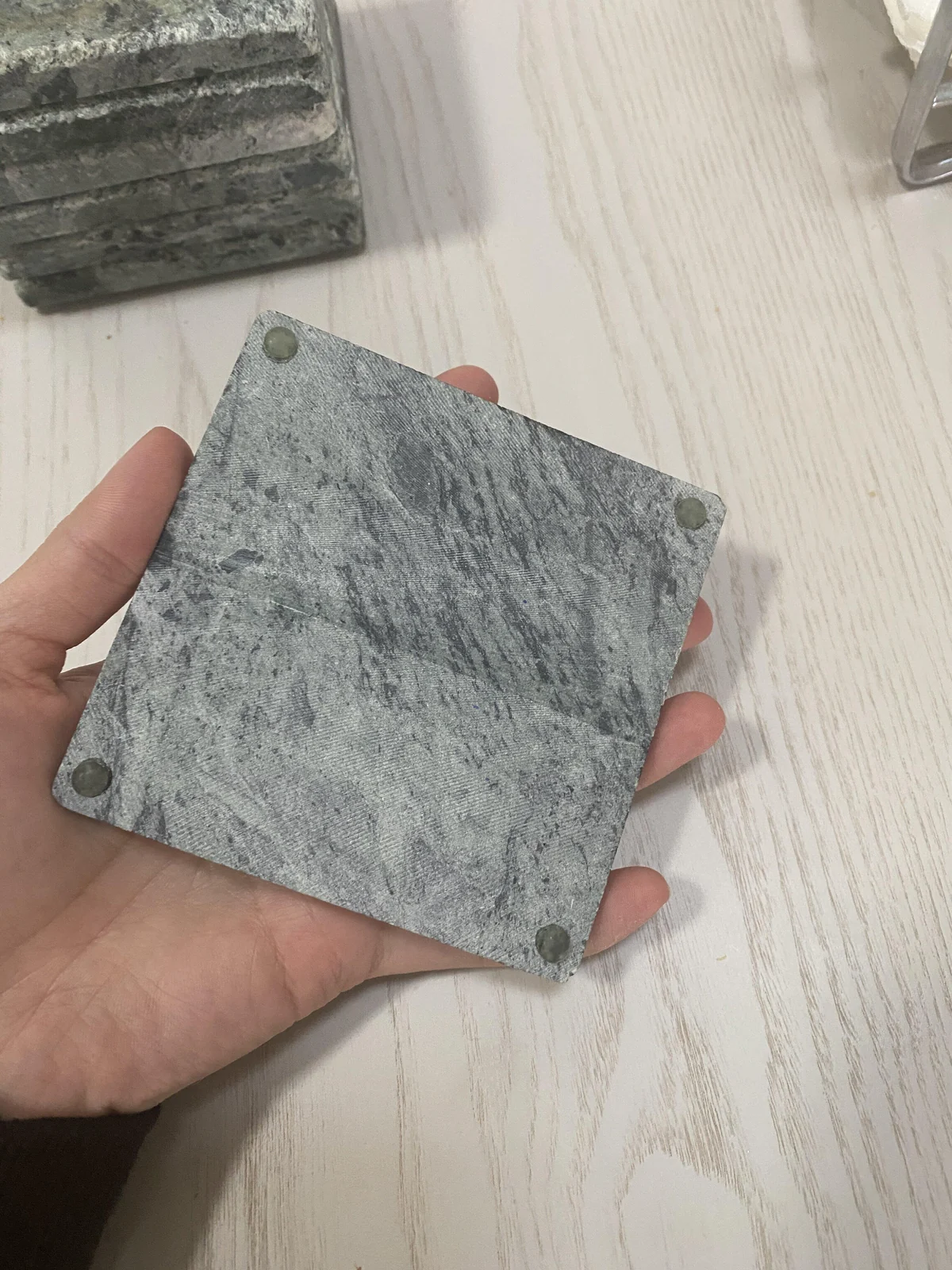
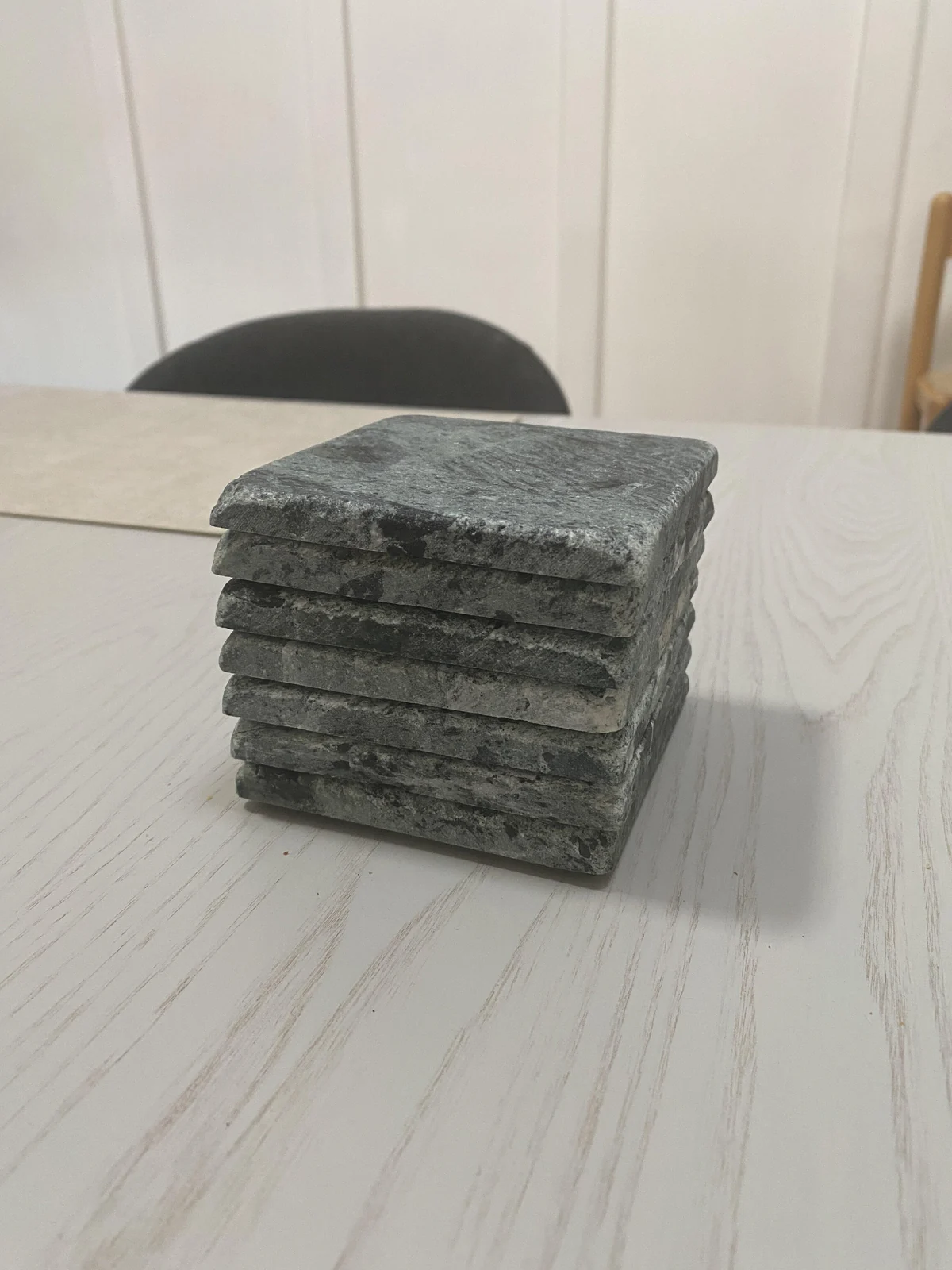
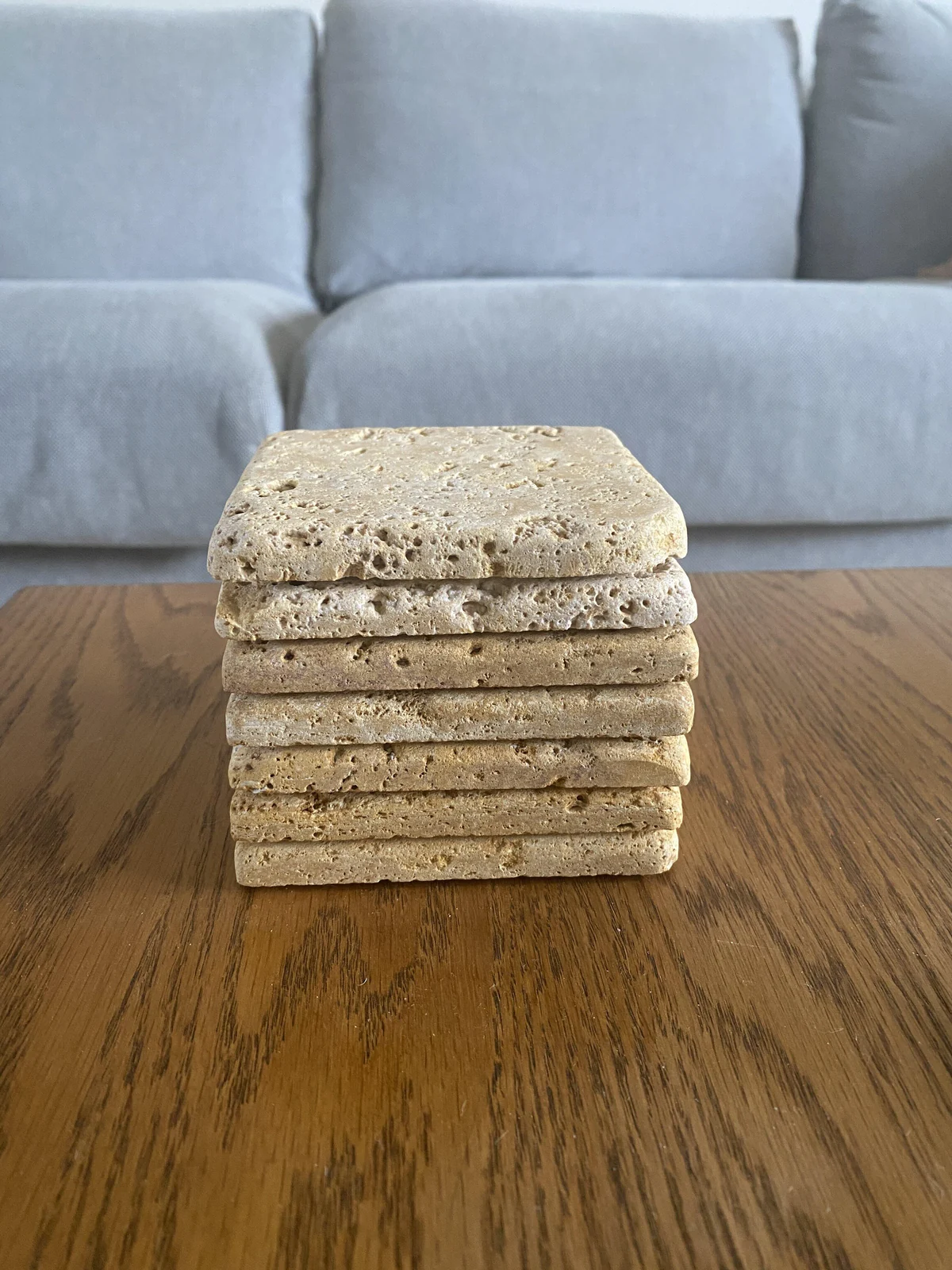
Supplied product photographs for discussing form, arrangement and visible appearance. Confirm stone identity, dimensions and suitability for your project through sample review; these references are not a stock catalogue or a customer delivery case.
Approve the stone, backing and adhesive together
Compare finished surfaces in use
Review honed and polished samples with the same drinkware and lighting. Check appearance after wiping, visible handling marks and the ease of cleaning around any engraving. Record the chosen finish with a retained physical sample. Explore the materials page when preparing the shortlist, then request confirmation of the actual stone proposed for the project.
Define the underside assembly
Specify the backing material, coverage, thickness, position and replacement method. Possible trial configurations include discrete feet or a shaped backing layer. Ask the supplier to identify the adhesive and confirm its intended use with the exact stone surface, treatment and pad material. Include the manufacturer’s preparation, curing and cleaning restrictions in the sample record.
Test the complete assembly on the hotel’s real furniture finish. Observe movement when a cup is set down, rocking under the intended vessel, marks on the table, pad-edge lifting and any visible change around the bond. Include repeated handling and the proposed cleaning routine. “Protective backing” is too vague to settle these questions.
If housekeeping will replace pads, specify the approved spare, placement template and instructions. Avoid allowing an unspecified substitute adhesive to become the default repair method.
Make stacking and separation part of the design
Define whether coasters will be stored individually, in a loose stack or in a holder. Check the actual stack with all pads fitted. Staff should be able to remove one piece without dragging adjacent stone faces together or lifting an unstable bundle.
For a holder, review its internal clearance, contact points, access for fingers and cleaning method. Confirm that the chosen coaster shape and backing fit together throughout the intended stack. Test both clean, dry pieces and pieces returned from a realistic service trial.
Keep transport separators distinct from reusable storage components. If a separator is needed during daily storage, include it in the operating instructions and sample approval. Relate the packed set to the shipping information, while keeping everyday stacking requirements in the product specification.
Place the logo around the cup zone
Show logo artwork at actual size and state the viewing direction. Choose whether guests should see it with a glass present, only after lifting the glass, or on the underside. Keep an underside mark clear of the agreed pad positions.
For engraving or another proposed marking process, request a finished sample showing contrast, detail and cleaning access. Check whether the vessel crosses the marked area and whether the mark interferes with stable placement. Approve the process and artwork revision together rather than approving a digital logo independently of the stone.
Define mixed sets and replacement rules
For mixed-colour or mixed-stone sets, provide a component list and quantity for each variant. Decide whether natural variation should look closely coordinated or intentionally contrasting. Photograph an acceptable range under consistent lighting and retain representative pieces. State any required arrangement inside the set.
Plan replenishment before ordering. Decide whether a lost piece may be replaced individually, whether replacements must belong to a particular colour group, and what happens if a later stone selection differs visibly. An approved range gives future reviewers a clearer reference than a single idealised photograph.
For small-batch stone manufacturing, a shared base geometry with documented variants can make the brief easier to manage. Discuss quantity and feasibility for the project through customization; do not assume a fixed minimum order or a permanently available stone selection.
Use a housekeeping and replacement sample matrix
The following is a proposed approval matrix, not a record of completed testing. Agree trial conditions, repetitions and acceptance criteria with the supplier and hotel team before testing. Keep an unused reference sample and identify every trial piece.
| Sample group | Hotel scenario | Record before approval |
|---|---|---|
| Largest-base glass | Centered and off-centre placement | Support area, rocking, edge clearance |
| Chilled drink | Normal service followed by clearing | Droplets, underside moisture, furniture condition |
| Finished and marked face | Proposed wipe-clean routine | Residue, appearance, access around logo |
| Complete backing | Handling and cleaning on intended furniture | Pad position, lifting, movement, visible marks |
| Full stack or holder | Remove, return and store pieces | Separation, contact points, staff access |
| Replacement piece | Introduce a spare into an approved set | Color range, finish, geometry, pad height |
Have housekeeping approve a written cleaning and drying method against the hotel’s hygiene requirements and the exact assembly. The Natural Stone Institute recommends neutral cleaners or mild detergent, thorough rinsing and soft-cloth drying, and warns against acidic cleaners. Read its care guidance.
Remove chipped pieces or loose-backed assemblies from service pending assessment. Record how staff report damage and where approved spares are held. Obtain specific cleaning instructions for the complete product before assigning it to a dishwasher, soaking routine or disinfection process.
Frequently asked questions
What size should custom marble coaster sets be?
Choose the size from the largest intended cup base and the usable flat surface. Allow for the edge profile and ordinary off-centre placement. Compare physical samples with the hotel’s drinkware instead of adopting a standard diameter without checking it.
Will marble coasters absorb all condensation?
Do not assume so. Approve condensation handling on the complete sample with the intended chilled glass. Record where moisture collects, whether it reaches the furniture and how the coaster will be dried between uses.
Which backing should a hotel specify?
Specify a backing and adhesive combination approved for the selected stone, treatment, furniture finish and cleaning routine. Document coverage, placement and replacement instructions, then check the assembled sample for rocking, movement, marks and pad lifting.
Can replacement coasters match the original set?
Use retained samples, an accepted colour range and a component record to assess replacements. Natural variation and later material availability can affect the result. Agree whether individual replacements or coordinated replacement groups are acceptable before ordering.
Send a specification for review
Send DeHong Stone your proposed dimensions, drinkware details and quantity, together with the intended hotel location, logo artwork and backing preference. Visit www.dehongstone.com, email hefeng@dehongstone.com, or discuss the brief on WhatsApp.
Sources
Sources checked on October 7, 2026. Product examples document their own published formats only.
- Natural Stone Institute: Care and Cleaning of Natural Stone
- Use Natural Stone: How to Care for Your Marble Countertops
- Crate & Barrel: Marble Coasters, Set of 4
- John Lewis: Round Marble Coasters and Gold Holder, Set of 5
For coordinating room accessories, compare the small stone tray collection and specify the proposed coaster separately; tray references do not establish coaster performance.
Buyer questions for this project
Start with the short answer, then expand the project considerations before preparing your brief.
Q: How should packaging be evaluated for small stone objects shipped internationally?
Short answer: Start with the actual dimensions and weight, vulnerable edges or separate parts, shipping method and required transport checks. Evaluate the proposed packing around the approved object.
Project considerations
Review surface separation, restraint and cushioning for the piece and any removable lid or accessory. Confirm the packed dimensions and weight before comparing courier or consolidated shipping. Agree whether representative shipment or packaging tests are needed and how results will be assessed. Workshop packing photographs show an arrangement, not a test result; no packing method establishes a zero-breakage guarantee.
Apply the guidance to your project
For a project-specific review, send your intended use, drawing or reference, dimensions, material preference, estimated quantity and delivery destination to DeHong Stone. The team can review which details need sample confirmation before quotation.
Website: www.dehongstone.com
Email: hefeng@dehongstone.com
WhatsApp: +86 139 8660 4493
General purchasing guidance is not a project quotation or a material test result. Confirm specifications, verification and terms for the selected sample.
Bring your drawing and project requirements.
Include your intended use, reference, dimensions, material preference and quantity. Agree the feasibility review and sample requirements in writing.